The way of life we are leading today is placing us under an enormous cognitive load. We constantly receive notifications, multitask, browse through our social media pages, and deal with stress at work. As such, our brain has no time for relaxation. It is one of the factors that contribute to the immense popularity of guided meditation today. Scientific research reveals that meditation should not be perceived as a spiritual practice only. Now, scientists know that meditation helps shape attention and emotion regulation mechanisms, stress reactions, and brain connectivity responsible for focus and self-awareness.

What Is Guided Meditation and How Does It Function?
Guided meditation involves listening to verbal cues that lead you to concentrate on your breathing, sensations, visualization, or mindfulness exercises. In contrast to silent meditation, guided meditation offers you structure, making it ideal for beginners. From a neuroscientific point of view, guided techniques assist in decreasing distraction while enhancing attention. Research using brain scans found that various types of meditation activate areas associated with self-consciousness, emotion regulation, and attention. In cases when you wish to try beginner guided meditation, you can easily concentrate since you are following a guiding voice.
Guided Meditations – Why They Will Be Even More Crucial in 2026?
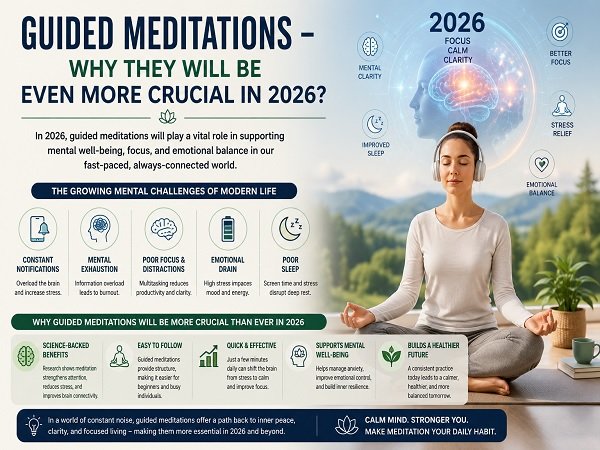
One of the main issues that many individuals face today is not bodily exhaustion but rather mental exhaustion. The constant stimuli provided by digital devices make our brains constantly switch tasks, thus decreasing the level of attentiveness and making us mentally tired. A recent scientific discovery claims that it only takes two to three minutes of meditation to change the brain activity from being excited to relaxed and attentive. According to an analysis of EEG results conducted in 2026, the maximum positive effect is achieved in about seven to ten minutes.
Relaxation meditation will thus be highly pertinent to all professionals and students overwhelmed with information.
Advantages of Guided Meditation for a Relaxed and Focused State
Reduced Stress Reaction: Another major benefit of meditation is that it has been shown to decrease stress. In situations involving stress, the body produces cortisol, which is also known as the stress hormone. It is believed that meditation practices assist in decreasing stress due to the fact that meditation promotes moving from automatic stress responses into a state of heightened awareness.
Enhanced Attention and Focus:
People commonly explore meditation techniques due to their inability to focus on a specific task. According to the latest study conducted at the University of Southern California (USC) Leonard Davis School, even 30 days of mindfulness exercises resulted in enhanced attention control, faster reaction times, and increased resistance to distracting factors. Researchers utilized eye tracking techniques and found significant changes in directing the participant’s focus.
Greater Control of Emotions:
It seems like meditation increases activity in certain regions of the brain responsible for emotional control. Clinical research using mindfulness-based approaches found improvements in anxiety disorders and increased emotional stability.
Improved Sleep Patterns:
Stress levels and sleep problems are related. Studies funded by the U.S. National Center for Complementary and Integrative Health found that mindfulness meditation improved the sleep quality of chronically insomniac patients.
Technique 1: Breathing Meditation
All forms of meditation include one that should be tried first, and that is breath awareness meditation, since breathing helps to keep the mind focused naturally.
How it works:
- Sit down comfortably.
- Observe your inhalation and exhalation.
- Keep the focus on breathing when attention wanders.
Frequent research has shown that focused-attention meditation trains the brain in directing attention back to the chosen object. Attention-related neural pathways are observed to be engaged during these kinds of meditative practices. For those who are starting their meditation journey, breathing is an easy technique to begin with.
Technique 2 – Body Scan Meditation
In body scan meditation, one’s awareness gradually scans various body parts with no judgment about their sensations. Body scan meditation is a form of relaxation meditation commonly practiced within mindfulness-based stress reduction programs. As per a review published in 2026, body scan meditation is considered one of the most extensively studied mindfulness techniques since there is research about its effects on sleep, anxiety, stress, and trauma recovery. There are also some studies reporting increased prefrontal connectivity due to body scan practice.
Technique 3: Guided Visualization Meditation
The practice of visualization meditation prompts the practitioner to imagine serene scenes such as the beach, the forest, the mountain range, or other tranquil environments. Imagining an environment utilizes the same brain regions engaged during perceptual experience. That is why imagining serenity induces genuine feelings of relaxation. As a technique with a well-defined mental focus, visualization continues to be one of the most useful forms of meditation, especially for those who cannot practice silent meditation.
Technique 4: Mindfulness Meditation
In contrast, mindfulness meditation involves being mindful of thoughts, emotions, and sensations while avoiding attachment to them. Studies have proven that mindfulness meditation is useful in boosting attentional control through distraction identification and returning the focus to the moment. Single meditation sessions have been demonstrated to result in improved ability to detect errors and monitor oneself.
That is why guided meditation based on mindfulness is recommended for those who are plagued by overthinking.
Technique 5: Loving Kindness Meditation
Compassion meditation refers to focusing your feelings of compassion towards oneself and other people. It is known from neuroimaging research that compassion-based meditation activates specific areas of the brain related to emotions and empathy. Each meditation technique seems to have its own network of activated brain areas based on its aim. Relaxation meditation is one type of meditation, and compassion meditation can be helpful for lowering self-criticism.
Meditation for Recovering from Digital Brain Fatigue
Digital brain fatigue is one thing that is not mentioned in most blog posts about meditation practices.
Individuals might not be tired physically but tired mentally.
Some symptoms that indicate digital brain fatigue are:
- Poor concentration
- Always checking for notifications
- Having mental clutter
- Shorter attention spans
- Being exhausted after screen time
Recent studies on attention have found that mindfulness meditation boosts individuals’ ability to resist distractions and increases their attention control.
One simple meditation technique:
- Close your eyes
- Breathe slowly
- Notice sounds without attaching any meaning to them
- Notice thoughts, but do not engage with them
- Focus on breathing again
This kind of meditation can be done by professionals who spend many hours on the computer as an attention recovery exercise between challenging assignments.
Mistakes Made While Meditating
A common misconception is that one needs an empty mind during meditation. This misconception is not supported by research. The objective is not to have an empty mind but rather to change the relationship with thoughts. Daydreaming during meditation is completely natural. Every time the mind comes back to the current state, the brain learns how to regulate its focus.
A further misconception is that it takes a long time to achieve positive results through meditation. Shorter periods of meditation, as little as 10 minutes, have been proven to be effective through research.
How to Create a Daily Meditation Routine?
Consistency counts more than frequency.
A routine of daily meditation lasting 10 minutes is usually better than weekly sessions lasting much longer. The study of attention revealed notable results achieved after 30 days of regular mindfulness practice.
Here are some ideas to build the daily meditation routine around:
- Upon waking up
- Before going to work
- Lunchtime
- Before sleeping
Sum up,
Living in an age where we are continuously bombarded by distracting thoughts, mental exhaustion has become a common issue. Fortunately, there is a straightforward solution to regain inner balance through guided meditation. From breath awareness meditation to body scan, from visualization to mindfulness, and loving-kindness meditation, all of these meditations will assist you in improving your focus, reducing stress levels, and helping with emotional balance. Science has proven the beneficial effects of meditating on our attention span, quality of sleep, and brain response in daily activities. All you need to do for positive outcomes is be consistent rather than perfectionistic. A few minutes of relaxation meditation on a regular basis will yield positive results for you. If you have never practiced meditation before, try a beginner’s guided meditation and take patience with yourself throughout the whole experience.