For beginners, the best thing one can do is make sure meditation is simple and clear-cut. One should sit in a comfortable position, either in a chair, on a bed, or on the floor, and then gently close their eyes. Concentrate on breathing, simply noticing the inhalation and exhalation process. This should be done for around 5 to 10 minutes. One’s mind will certainly wander; however, this is quite natural. One should not be bothered by it or get annoyed; all that one should do is concentrate on the breath once again.
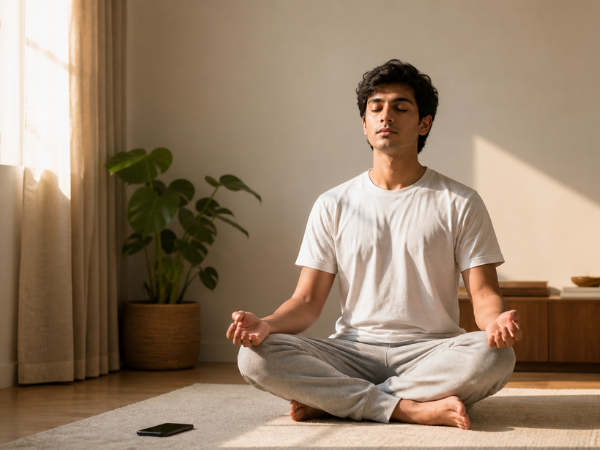
Beginner Meditation Essentials You Must Know
No need for silence when starting meditation
Just 5 to 10 minutes per day is fine
Minds wandering during meditation is normal
Focusing on breath is an easy technique
Why Is Meditation Important in 2026?
These days, our minds never stop. From the time we wake up, our mornings consist of checking our phones, scrolling through our social media feeds, replying to various notifications and emails, and dealing with work-related issues. All of this does not provide enough time for us to pause and reflect.
This unending mental work keeps the brain under constant pressure without us realizing it.
That is exactly why meditation will be crucial for you in 2026. It gives your brain some rest from constant stimulation, thus making you slower and calmer. A few minutes of sitting in silence and thinking about your breathing can make you feel less overwhelmed.
The benefits of meditation were proven by science a long time ago. For example, according to Mayo Clinic, meditation can decrease stress levels in patients. Moreover, a study conducted by the Journal of the American Medical Association found that mindfulness meditation can ease anxiety, depression, and stress in most people.
In other words, meditation does not just serve as a calming method. In the modern world, it has become an essential one.
What Meditation Really Entails (and What It Does Not Entail)
First, it is important to clarify the misconceptions regarding meditation that are shared by most new practitioners.
Meditation can be described as the process of paying attention to the present moment. This includes being mindful of your breathing, your physical presence and, last but not least, your thoughts. When you catch your mind wandering, you do not have to suppress the ideas. Instead, you observe them, without reacting, and then bring your focus back — repeatedly.
It is worth noting that meditation is never a process of totally clearing your mind. This is not something that you can force your mind to do. Moreover, meditation is not something that will leave you feeling relaxed as soon as you get up from the chair. These notions of what meditation should be like are simply not realistic and tend to demotivate many individuals.
The point is, your mind is supposed to think. There will always be thoughts, both related to your work and others. The goal of meditation is not to fight these thoughts, but to change your relationship with them.
By grasping this point, you become ready to enjoy meditation without striving for unrealistic results.
According to a research study conducted by Harvard University, people dedicate nearly 47 percent of their conscious state to thinking about anything but the here and now. This explains why your mind tends to wander when meditating. Thus, redirecting one’s attention is precisely how to practice meditation.
How To Begin With Meditation (Easy Steps)
Are you wondering how to begin with meditation? Try this easy method:
Step 1: Sit comfortably
Can be done from a chair, bed, or floor.
Step 2: Use a timer
Beginners can start with 5-10 minutes.
Step 3: Concentrate on breathing
Feel your breath in and out.
Step 4: Mind will wander
But bring it back softly.
Step 5: Finish without making judgments
These steps are enough for anyone learning to meditate.
Forms of Meditation that You May Undertake
Everyone has their preference.
1. Breathing Meditation
Concentrate on your breaths.
2. Body Scanning Meditation
Be aware of bodily sensations.
3. Guided Meditation
Follow instructions carefully.
4. Mantra Meditation
Repetition of mantras.
All these kinds of meditation are said to be beneficial as they have been shown to ease stress and boost concentration by National Center for Complementary and Integrative Health.
Common Mistakes Beginners Make
Most beginners quit because of wrong expectations.
| Mistake | Reality |
|---|---|
| “I can’t stop thinking.” | You don’t need to |
| “I need long sessions.” | Short works |
| “I feel distracted.” | That’s normal |
| “No results quickly.” | It takes time |
Research from the American Psychological Association shows that mindfulness builds gradually and improves mental control over time — not instantly.
How to Form a Meditation Practice Each Day?
To start meditating is very simple; however, maintaining this process daily seems challenging for most people. In order to do so, one should not rely on motivational efforts. The point is to create a routine that will be both easy to perform and comfortable for you.
First, decide on the time of day that will be suitable for this purpose. One can practice early in the morning before starting his or her activities, or just before going to bed at night. As for the duration of meditation, try to begin with very short periods. It may seem sufficient to spend about 5 minutes performing it daily.
Furthermore, you should combine this process with some activity that you usually do. For instance, practice sitting and meditating immediately after brushing teeth or before going to bed. Also, avoid interrupting sessions for more than a few days; it will be difficult to continue.
Thus, the main advice that could help in developing the habit of meditation is to keep things simple. There is no need to put much effort into practicing this activity.
What You’ll Really Experience
Let’s face it.
Week 1
Restless
Boring
Mind Wandering
Weeks 2 – 3
Slightly calmer
Increased awareness
At the one-month mark
More calm thoughts
Quick reactions
Meditation is like working out, but for your brain. It requires patience.
Meditation for the Distracted Mind
It’s not something many blogs mention correctly.
Right now, the biggest challenge is distraction.
Phones keep buzzing. Attention is disrupted.
Here’s a more modern approach:
1. Two Minutes of Meditation
Take two minutes to meditate while sitting.
2. Phone Pause
Before picking up your phone, take one breath.
3. 60-Second Eye Closure
Close your eyes for one minute after spending time in front of screens.
Such practices help you develop your concentration skills in real life.
Science suggests that even brief meditation practices help increase focus.
Guided vs Silent Meditation
| Type | Best For |
|---|---|
| Guided | Beginners |
| Silent | After practice |
If you’re starting, guided meditation is easier. Once you learn how to meditate properly, silent meditation works better.
How Long Do You Need To Meditate?
The short answer:
Beginner: 5–10 minutes
Intermediate: 10–20 minutes
Expert: 20+ minutes
Shorter meditation sessions are effective if practiced regularly.
Conclusion
Meditation is very easy to learn but requires regularity for effectiveness. Beginners do not have to be perfect in their meditation practices since the only key ingredient of successful meditation is consistent daily sessions. It is not important whether the sessions are too long or too short, as long as one makes them consistently. Moreover, meditation for beginners does not require complicated techniques.
The best advice that can be given to a beginner is to remember three crucial aspects of meditation. First, it involves sitting in a comfortable position; second, taking regular breaths; and third, focusing on those breaths. It is natural that your thoughts will keep drifting away from their object of attention, and that is not a problem as long as the mind returns to its rightful place. That simple act of refocusing one’s attention is the real meditation exercise.
Most beginners tend to make things unnecessarily complicated by imagining that they should feel calm after just a minute or two into their sessions. In reality, however, meditation for beginners becomes simpler if one stops making it complicated. Each session is unique and cannot be measured against the standard of perfection.