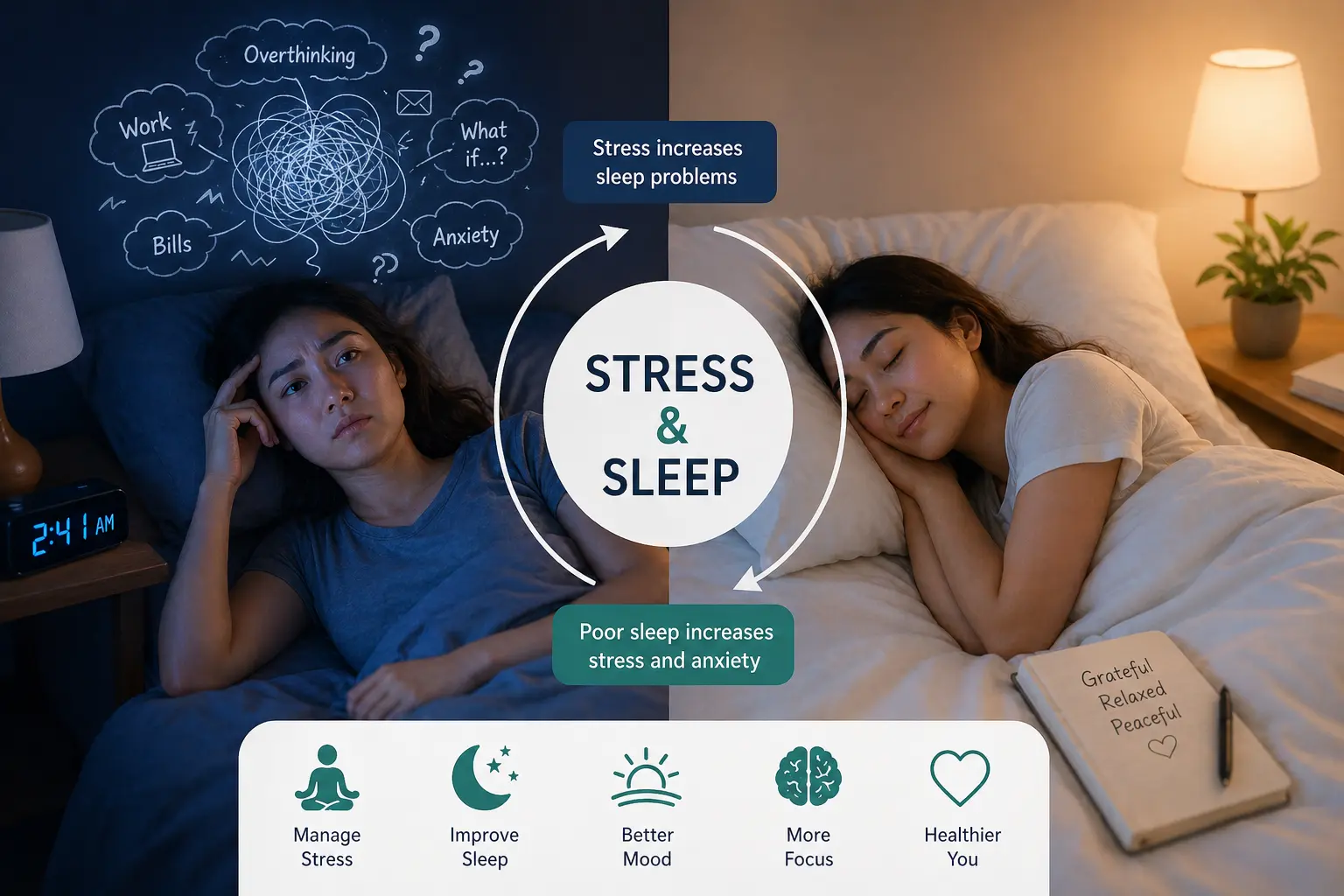
The relationship between stress and sleep is bidirectional. Stress increases sleep problems, and poor sleep increases the perception of stress. This process may become a vicious circle. However, stress-reduction techniques, stress-relaxation techniques, stress-reduction strategies, and stress-control knowledge can be useful for improving your sleep and maintaining your physical and psychological well-being.
Quick Summary: How Stress and Sleep Affect Each Other
- Stress makes it difficult to fall and stay asleep.
- Lack of sleep will cause you to be more vulnerable and anxious, and increase your feeling of being overwhelmed.
- High levels of stress may impair deep sleep and leave you exhausted regardless of a full night in bed.
- Daily methods of dealing with stress can be helpful in improving your sleep quality.
- Some recent studies have revealed a new concept called sleep reactivity.
Why Stress Makes It So Hard to Fall Asleep
Have you ever found yourself feeling sleepy, but you cannot fall asleep since your mind refuses to relax? This shows the relationship between stress and sleep. However, besides interfering with mental functions, stress can also cause changes to our physical well-being, hormonal levels, breathing, and sleep cycle. Moreover, lack of sufficient sleep may aggravate the stress experienced in the coming day.
The scientific research confirms this relationship. In particular, according to a study published in the Journal of Sleep Research, stress can negatively impact one’s sleep and increase the chances of insomnia development in individuals with high sleep reactivity when experiencing stress. Therefore, knowing how to alleviate stress may not only be beneficial for our peace of mind.
How Stress Disrupts Your Sleep Cycle
In times of stress, our bodies are in an activated mode. We become more sensitive and aware of our environment.
It translates into:
Taking a long time to fall asleep
Getting woken up in the middle of the night
Shallow and fragmented sleep
Awakening early in the morning
Here is where relaxation and stress management skills come in. Simple actions like a regular sleep schedule, a calm bedtime routine, and limiting information intake can reduce stress.
Additionally, some individuals find themselves waking up at 3 AM and not being able to fall back asleep. In some instances, stress might be a contributing factor because of the activation of the body.
Why Poor Sleep Makes Stress Feel Worse
This is the flipside that is overlooked by many people. Sleep deficiency exaggerates daily hassles. Minor issues become aggravating. Decision-making becomes complicated. Our patience starts fading away. Thus, when creating strategies for relieving stress, we need to consider the protection of sleep, too. Once our sleep quality improves, we start feeling that our ability to manage stress has significantly improved.
Signs That Stress Is Causing Sleep Problems
The signs that you may be struggling with sleep problems caused by stress include:
Feeling sleepy, but your mind is racing, and you can’t stop
Waking up in the night, worried about work or other issues
Being physically tense when trying to go to bed
Getting inadequate sleep even after spending the required time in bed
Sleep worsens whenever there are stressful times
Early recognition means early prevention of greater problems.
The Vicious Cycle of Stress and Sleeplessness
This is a familiar pattern:
Stress goes up
↓
Your sleep is disrupted
↓
You become more sensitive the following day
↓
Stress seems harder to cope with
↓
Your sleep becomes even more disrupted
That’s why stress reduction strategies are important.
Consequences of Chronic Stress on Sleep
Sleep is not just about quantity. Sleep quality also counts.
As your chronic stress levels remain elevated, you might find yourself sleeping lightly. It means that while you spend sufficient time in bed, you wake up feeling exhausted.
It could impact:
– Energy
– Concentration
– Mood
– Emotional stability
This is yet another benefit of lowering your stress levels, which will also positively influence your sleep.
8 Ways to Manage Stress That Will Help You Get to Sleep
1. Clear Your Head Before Bedtime
Make a list of tasks you need to do the next day.
2. Practice Slow Breathing
Try simple breathing exercises; they will help you transition to relaxation mode.
3. Avoid Stressful Activities in the Evening
Avoid working on complicated tasks, discussing contentious issues, and solving problems in the evenings.
4. Avoid Doomscrolling
Staying online late into the night can prevent your brain from shutting down.
5. Walk Regularly
Even taking an evening stroll can lower stress levels.
6. Go to Bed at the Same Time Every Night
Having regular sleep habits can regulate your sleep cycle.
7. Consider Relaxation Techniques
A lot of people recommend body scans and listening to relaxation music.
8. Explore CBT-I Approaches
It is a recommended first step in the case of chronic insomnia.
These are all examples of stress management strategies, simple stress management approaches, and effective stress reduction techniques.
Daily Stressors Which May Increase Your Stress at Night
It is important to note that your issue may not be bedtime, but all those things that happen throughout your day.
Stressors include:
Caffeine in large amounts during the late afternoon
Phone notifications
Neglecting taking breaks
Late-night working
Large meals close to bedtime
Cutting down on these could help if you want to learn about reducing stress naturally.
Sleep Reactivity – Why Some People Experience Sleep Loss More Quickly Under Stress
A topic that most blogs do not talk about.
Two people who experience similar stresses might have completely different reactions with regard to sleep.
Why does this happen?
The answer may lie in sleep reactivity.
This indicates that the sleep in some individuals may be highly reactive to any form of stress.
According to some studies, those who experience more sleep reactivity may easily be affected by stresses that could cause insomnia.
This gives us a fresh perspective on managing stress since not only does it mean managing the stresses, but also ensuring one’s sleep system becomes resilient.
Stress Relief Techniques for Nighttime When Your Brain Is Refusing to Sleep
Consider these:
- If you stay awake for too long, get out of bed and take a break.
- Maintain dim lighting.
- Don’t push yourself to fall asleep.
- Use progressive muscle relaxation techniques.
- Ensure that the room is cool and quiet.
- Don’t keep looking at the time.
These easy stress relief techniques can prevent you from becoming frustrated.
How to Avoid Stress During the Day to Sleep Better at Night
Nighttime sleeping begins in the daytime.
Good practices:
- Go out in the morning sun
- Exercise
- Relax your mind
- Set limits while working
- Do not accept all requests
In some cases, the simplest response to how to avoid stress is taking away the overburden rather than adding techniques.
When to Seek Assistance
Consider seeking assistance if:
Insomnia persists for several weeks
You feel unable to cope with your stress
You experience panic attacks at night regularly
Lack of sleep impacts your performance at work and elsewhere
Some individuals might find stress management and CBT-I useful.
Conclusion
The connection between stress and sleep is intricate. One aggravates the other. But the pattern can be disrupted. Simple activities, tips for managing stress, methods of coping with stress, and reducing stress in general might make a difference. It does not necessarily mean that you must follow an exact schedule every day. Sometimes, all that is required is consistency.
Research That Backs up This Blog
Clinical practice guidelines recommend CBT-I as the first step in treating insomnia.
Research has shown that individuals with high sleep reactivity may be more prone to having insomnia because of stress.
About 33% to 50% of people struggle with insomnia based on the findings of published studies on the topic.
Review studies have shown CBT-I is effective in increasing sleep initiation, reducing wakefulness at night, and improving sleep efficiency.
Hyperarousal resulting from stress is one cause of the negative effects stress has on falling and staying asleep.