It is typical of many children to seem self-confident, responsible, and successful from the outside. They turn in their homework assignments on time, do exceptionally well in school, follow all instructions, and hardly ever misbehave. As a result, adults easily assume that everything is going smoothly with such children. Nevertheless, some children suffer from hidden anxiety that is often referred to as high-functioning anxiety. Although high-functioning anxiety is not considered to be an official diagnosis, the term has become quite popular to refer to those kids who seem to be successful yet have to cope with anxiety at the same time.
According to statistics provided by the U.S. Centers for Disease Control and Prevention (CDC), anxiety is a rather widespread problem of mental health experienced by millions of children around the globe. The earlier anxiety is diagnosed, the easier it will be to avoid its detrimental effects on kids’ emotional state.
What Is High-Functioning Anxiety in Children?
Children can have high academic performance, behave properly, and still have to deal with anxiety issues daily. The term high-functioning anxiety refers to anxiety that does not always become obvious since the child remains successful despite having the issue. Such children tend to seem organized, responsible, and motivated. They might excel in studies, sports, music, or any other activity. However, at the same time, these individuals will feel concerned about making mistakes or not living up to expectations. They may achieve things due to fear rather than self-confidence. As opposed to children who show signs of anxiety in their behavior and emotional reactions, children with high-functioning anxiety tend to hide their problems.
High-Functioning Anxiety As a Diagnosis
There is no separate diagnostic category called high-functioning anxiety in psychiatric literature. It refers to a particular behavior pattern that can be observed in children suffering from anxiety and maintaining good functioning simultaneously. Such children can have certain disorders like generalized anxiety disorder and social anxiety disorder, but appear very successful. It is one of the main reasons why many high-functioning children go undiagnosed. The parents only see the achievements without noticing the constant stress the kids suffer.
Reasons Why High-Functioning Anxiety Can Be Hidden
These children usually cope with schoolwork excellently, so everyone assumes that they feel happy. Most anxious children develop great coping strategies. They are afraid to talk about what bothers them, not to burden people around them. Teachers call them diligent and dependable. Parents say that they are mature for their age. Of course, these traits can be useful, but they may cover up anxiety. That is why this kind of condition can persist for a long time before anyone notices what really happens to the children.
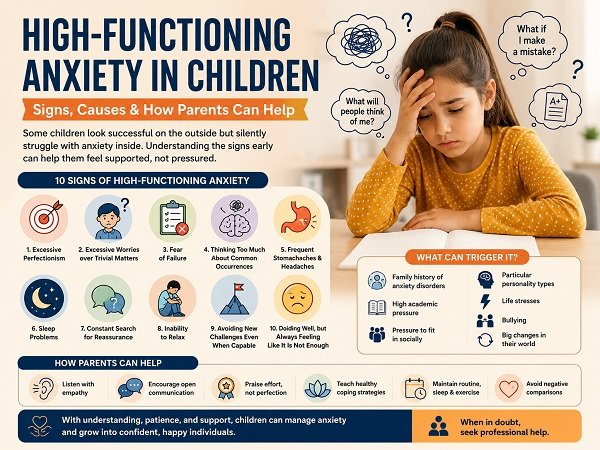
10 Symptoms of High-Functioning Anxiety in Kids
1. Excessive Perfectionism
Sometimes, a few subtle changes in behaviour might reveal more than we think about a kid’s state of mind. Kids suffering from high-functioning anxiety typically have exceedingly high expectations for themselves. They get easily frustrated with even minor errors made by them. Making a spelling mistake, scoring fewer marks than they expected, and not being able to reach their goals; they take all this too hard. It is because they have been brought up with the idea that they need to do things perfectly. There are enough scientific studies supporting the link between perfectionism and anxiety in kids and teens.
2. Excessive Worries Over Trivial Matters
While most kids get worried from time to time, those with high-functioning anxiety tend to be excessively worried about matters that others consider trivial.
Such kids tend to constantly wonder things like:
- What if I miss my homework?
- Next, What if I make an error?
- What if people reject me?
Despite reassurances, the fears continue to surface.
3. Fear of Failure
Some children who have anxiety issues tend to avoid scenarios that may lead to failure or embarrassment. Such fears cause them to be extra cautious, to redo things or not even attempt new things at all due to fear of failure.
4. Thinking Too Much About Common Occurrences
High-functioning children with anxiety often find themselves analyzing common occurrences constantly in their heads. They could think about what they have said, how others might have responded, or if they did something correctly. All these thoughts in their head can exhaust them, leaving them unable to rest or sleep.
5. Suffering From Frequent Stomachaches and Headaches
Anxiety affects more than just the mind. In fact, there is evidence that anxious kids experience stomachaches and headaches despite no medical condition being detected. Stomachaches and headaches are among the most common physical manifestations of anxiety in kids. They usually occur before a test or exam, before going to school, or before social interactions.
6. Sleep Problems
Sleep disorders can happen to children when they have anxiety. Some children do not sleep at night as they cannot relax even late into the night. Others find themselves waking up at night as they keep worrying about future occasions. Inadequate sleep causes irritability and makes it difficult for children to concentrate since it also increases the symptoms of anxiety.
7. Constant Search for Reassurance
Most children need constant reassurance sometimes, but anxious children do so repeatedly by asking the same question over and over, even when they get an answer. Children with anxiety need answers to questions to reassure them, as they do not like uncertainty. They will continually ask such questions as whether they did well, whether anyone is angry with them, and whether everything is fine.
8. Inability to Relax
Although most children relax when they take their vacation days, some cannot relax regardless of the day. They cannot relax when having free time as they keep worrying about future activities, tests, and other worries.
9. Avoiding New Challenges Even When They Are Capable of Them
It is worth noting that even though kids with high-functioning anxiety are highly gifted, they tend to avoid new challenges. For instance, they can reject positions of responsibility and any activities that carry a risk of failure or criticism. What usually shocks the parents is the fact that the child has all the necessary capabilities to complete an assigned task successfully.
10. Doing Well, but Always Feeling Like It Is Not Enough
Inability to appreciate their success is among the most typical symptoms. Even when praised by someone else or when reaching their goals, they do not concentrate on positive moments. Their thoughts keep going around what could have been done better or what they need to achieve next.
What Triggers High-Functioning Anxiety in Kids?
Typically, the triggers for anxiety include the combination of personality, experience, and environment.
There are rarely any single factors, but several can work together, such as:
- A family history of anxiety disorders
- Particular personality types
- High academic pressure
- Pressure to fit in socially
- Life stresses
- Bullying
- Big changes in their world
Some children just have a naturally nervous disposition, making them more likely to experience anxiety due to environmental triggers.
Differences between Normal Child Worry and High-Functioning Anxiety
Children always get worried. However, worrying before an exam, a presentation, or the first day of school is completely natural. However, the key differences lie in the fact that high-functioning anxiety usually comes with increased severity, frequency, and persistence. While regular worry dissipates after the worry-provoking event ends, anxiety persists regardless of whether or not there are any immediate threats present. Worries that interfere with sleep, one’s disposition, relationships, physical well-being, and other aspects should not be overlooked.
How Modern Achievements Have Increased Anxiety in Children?
Many children in modern days are made to feel the need to achieve at all times without any margin for failure. Modern day children are faced with pressures that their predecessors never had. Social media makes them constantly compare themselves. There is stiff competition in most learning institutions. There is a focus on successes while difficulties go unnoticed. Some children are made to feel from an early age that their self-worth will be determined by their grades or level of success.
There have been increasing concerns raised about the impacts of constant comparisons and achievement pressures on children’s mental health by psychologists. Where children have feelings of always needing to succeed, anxiety is inevitable.
Tips for Parents’ Role
It’s not about eliminating all challenges but about enabling kids to cope with them.
Parents can empower their kids through:
- Empathetic listening
- Open communication
- Rewarding efforts rather than perfection
- Healthy coping strategies education
- Establishing routine
- Ensuring regular sleep and exercise
- Avoiding negative comparisons
Kids can derive enormous confidence from being appreciated for who they are, regardless of their achievements. Providing a safe environment where mistakes are accepted can reduce kids’ stress and increase resilience.
When a Child Needs Help from Professionals
Seeking early treatment will ensure that anxiety will not become more difficult to treat in the future.
If the child’s anxiety interferes with his academic success or results in physical symptoms, affects his ability to maintain friendships, or causes him to suffer considerably, and lasts several months or prevents the child from engaging in regular activities, parents should seek professional help.
One type of therapy that has been proven very successful for treating anxiety among children includes cognitive behavioral therapy, which shows children how to recognize their anxious thoughts, challenge them, and learn new coping strategies.
Conclusion
Early detection of anxiety may be of great importance in terms of building up your child’s self-confidence and increasing their levels of joy. It is quite hard to notice high-functioning anxiety in children as they tend to act quite mature and responsible. However, there are numerous fears that only a few may detect. In case you know what symptoms to watch out for and how to help them deal with those anxieties, children will feel loved, cared for, and understood. Some scientific claims are proving that children who have never had treatment for their anxieties have greater chances of facing various problems related to their emotional state, behavior, and academic performance. Nevertheless, if detected early enough, children can become happy, successful people.