The state of mind is affected by the interplay among processes in the brain, the nervous system, hormonal balance, and daily routines. Anxiousness is not related exclusively to emotions; it is also associated with the quality of sleep, physical activity, levels of stress hormones, attention span, and even technology use throughout the day. New studies, as presented in the article from the Nature Human Behaviour journal, have shown that everyday lifestyle factors, such as sleep and physical activity, play an important role in the result of mental health. The research link can be inserted here as an example of supporting evidence. The process of Learning How to Reduce Anxiety begins with the realization of how much daily life affects the stress response system in the body.

How to reduce anxiety dailyWhen people experience a lot of stress, they look for fast fixes to make themselves feel better. But true mental health comes from doing things repeatedly that nourish our mind and body every single day. In the year 2026, mental health professionals have started looking more into the habits we can form as preventive measures rather than when the stress has become too much to bear. The idea isn’t to eliminate all stress in our lives. It is to increase our capacity to cope with it.
Why Daily Habits Matter for Anxiety?
The human brain is constantly collecting information from the environment. Every notification, conversation, task, and decision requires processing power. When the brain receives more information than it can comfortably manage, stress levels can increase.
Anxiety often develops when the nervous system remains in a state of alertness for long periods. This continuous activation can affect concentration, sleep, mood, and energy levels. Daily habits work because they influence the biological systems responsible for managing stress.
Instead of focusing only on emotional symptoms, it is important to support the systems that regulate emotions. These include:
- The nervous system
- Sleep cycles
- Hormone regulation
- Brain energy management
- Physical recovery processes
When these systems function properly, emotional balance becomes easier to maintain.
Begin Your Day With Morning Light
Perhaps one of the least considered practices for good mental well-being is morning light exposure. Sunlight assists in setting our circadian rhythm. Circadian rhythms control our sleep and wake cycle, hormonal release, our energy, and alertness. Disrupted circadian rhythms can result in the rise of stress hormones during an inappropriate time of day. Morning light exposure allows our brain to know when the day starts, making our nighttime sleep easier and improving our mood stability.
Scientists have found that morning light exposure on a consistent basis increases our alertness, regulates emotions, and decreases feelings of mental fatigue.
Easy methods to achieve morning light exposure can be:
- Opening your curtains right away when you wake up
- Spend some time outdoors in the morning
- Go for a morning walk
- Work in areas with natural light if possible
Keep Moving Your Body throughout the Day
Exercise impacts much more than simply the state of one’s body. Exercises have effects on the body’s circulation, activity of the brain, release of stress hormones, and the nervous system’s plasticity. Physical exercises lead to the release of substances in the brain that help regulate emotions and provide relief from stress. Our modern life usually implies spending much time sitting.
Spending long periods of time being inactive may cause physical tension, fatigue, and stress. There is an effective solution used by modern Anxiety Relief Tips, which consists of moving your body during the whole day rather than working out once. Such types of exercises as walking, stretching, cycling, strengthening, and mobility exercises may work. The most essential thing about this is regularity. Several exercises throughout the day may decrease physical stress build-up and improve mental performance.
The Effect of Sleep on Mental Health
Sleep is the biggest determinant of emotional well-being. While asleep, the brain organizes information and memories, heals the body’s cells, and controls the emotions experienced during the day. Bad sleep interferes with the brain functions that help to make decisions and regulate emotions. Bad sleep makes ordinary problems seem more complicated than they are. It also causes irritation, anxiety, and mental exhaustion.
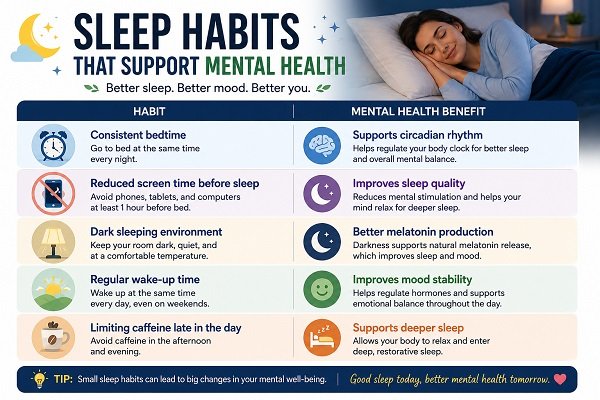
Sleep Habits That Support Mental Health
| Habit | Mental Health Benefit |
|---|
| Consistent bedtime | Supports circadian rhythm |
| Reduced screen time before sleep | Improves sleep quality |
| Dark sleeping environment | Better melatonin production |
| Regular wake-up time | Improves mood stability |
| Limiting caffeine late in the day | Supports deeper sleep |
Many people looking for How to Reduce Anxiety focus on daytime habits while overlooking sleep quality. However, poor sleep often amplifies anxiety symptoms throughout the following day.
Reduce Digital Overload
The average person receives more digital information today than ever before.
Phones, computers, social media platforms, messaging apps, and news feeds compete for attention every minute. While technology provides many benefits, excessive digital exposure can create mental fatigue.
Every notification causes the brain to shift attention. These constant interruptions increase cognitive workload and make it harder to maintain focus.
The nervous system never gets a chance to fully relax when attention is constantly divided.
Helpful strategies include:
- Turning off non-essential notifications
- Scheduling screen-free periods
- Avoiding excessive news consumption
- Taking breaks between work sessions
- Creating technology-free zones at home
These changes reduce unnecessary mental stimulation and support emotional recovery.
Understand the Gut-Brain Connection
Mental health is not controlled by the brain alone.
Researchers continue to discover strong connections between digestive health and emotional well-being. This communication system is often called the gut-brain axis.
The digestive system contains billions of microorganisms that influence inflammation, hormone activity, and neurotransmitter production. These processes affect mood, focus, and stress responses.
Nutrition habits that support mental well-being include:
- Eating balanced meals
- Drinking enough water
- Including fiber-rich foods
- Consuming adequate protein
- Limiting excessive processed foods
Modern research increasingly supports nutrition as an important part of mental health management rather than simply a physical health concern.
Train Your Breathing System
Breathing patterns directly influence nervous system activity.
When people feel anxious, breathing often becomes shallow and rapid. This signals the body to remain alert. Over time, this pattern can reinforce stress responses.
Slow breathing activates the parasympathetic nervous system. This system is responsible for recovery, relaxation, and restoration.
Regular breathing exercises help improve emotional regulation by teaching the body how to shift from a stress state into a recovery state more efficiently.
Many evidence-based Anxiety Relief Tips include breathing techniques because they can be practiced anywhere and require no special equipment.
Even a few minutes of controlled breathing each day can contribute to better stress management.
Build Better Attention Habits
Attention has become one of the most valuable mental resources.
Anxiety often pulls attention toward future concerns and possible problems. The brain becomes trapped in cycles of repetitive thinking.
Attention training helps interrupt these cycles.
Activities that improve attention control include:
- Mindfulness practices
- Focused reading
- Journaling
- Deep work sessions
- Meditation
The goal is not to stop thoughts completely. The goal is to improve the ability to direct attention intentionally. This skill becomes increasingly important in environments filled with constant distractions.
Create Predictable Daily Routines
The brain prefers predictability. When routines become inconsistent, the brain must make more decisions and process more uncertainty. This increases mental workload. Predictable routines reduce decision fatigue and allow the brain to conserve energy for more important tasks.
Helpful routine-building habits include:
- Waking up at the same time daily
- Scheduling meals consistently
- Creating regular work blocks
- Planning exercise sessions
- Establishing bedtime routines
Many mental health professionals recommend routine building because it creates stability even during stressful periods.
Strengthen Social Connections
Humans are inherently social creatures. Healthy relationships have an impact on the levels of stress hormones, resilience, and general mental well-being. Having strong social support is beneficial for coping with stress. Social connection doesn’t necessarily involve large groups of people and frequent interaction. Meaningful conversations and healthy relationships often prove to be the most beneficial.
More research continues to prove that loneliness is detrimental to one’s mental and physical well-being. Having healthy connections helps maintain emotional stability and provides psychological support in difficult situations.
Schedule Recovery Time
People tend to schedule their work, appointments, and other obligations, but few people schedule recovery time. The nervous system requires regular periods of decreased stimulation. Otherwise, stress starts accumulating and impacts mental performance.
Recovery activities could be:
- Going for a walk
- Reading
- Listening to soothing music
- Sitting in nature
- Relaxation practices
Often, people confuse productivity with constant activity. Actually, it’s much easier to increase one’s mental performance with recovery included. Experts who talk about how to Reduce Anxiety point out the importance of having recovery time because it enables the nervous system to regain balance after stress.
Improve Your Physical Environment
Environmental factors affect the mental health of individuals to a greater extent than they think.
A messy environment requires more visual processing. The brain has to constantly sort through irrelevant data.
A clean environment helps in lowering the level of cognitive effort.
Some changes that you can make are:
- Maintaining an organized workspace
- Removing any extra mess
- Improving lighting
- Having quiet places for concentration
- Maintaining comfortable temperature conditions
Track Habits Instead of Chasing Motivation
Motivation is always changing. Systems provide stability. One of the major trends in mental well-being studies during recent years is behavioral tracking. It is used to understand the patterns that connect certain behaviors to certain moods.
The most useful habits to track are:
- Amount of sleep
- Intake of water
- Activity level
- Time spent using screens
- Stress levels
- Mood changes
Awareness is created by tracking. And it makes improving your habits easier. Another great way to cope with anxiety, as mentioned in Anxiety Relief Tips, is thinking in terms of systems rather than motivation. Systems work regardless of motivation.
Sum up,
Good mental health is developed through habits that are practiced on a daily basis, not through sporadic activities. Patterns work best in relation to the brain and body; therefore, it is usually the smaller habits that are practiced more often that yield better results than big leaps in terms of behavior. Healthy sleep patterns, physical activity, proper nutrition, breathing exercises, good routines, lessening digital overloads, and conscious recovery all aid the systems that regulate emotions. The management of anxiety becomes more efficient when done on a systemic level, not on a symptomatic one. Regardless of future developments in scientific knowledge regarding anxiety in 2026, there is one thing that becomes clear: good mental health is achieved by helping the brain and nervous system function every single day.