What Is Guided Meditation?
Guided meditation can be defined as a form of meditation where verbal instruction is used in order to assist you in focusing your mind, breath, visualization, or thought. Unlike traditional meditation, where a person meditates alone, guided meditation requires you to be led by someone in each step that he or she makes during meditation.

During the last ten years, guided meditation has grown very popular among people in the world. According to the Global Wellness Institute, mindfulness and meditation have become increasingly prevalent for people as they search for natural means of managing their stress, getting adequate sleep, and improving focus. It has also been found that meditation causes the body’s relaxation reaction, reversing chronic stress through research carried out at Harvard Medical School.
If you are looking to reduce stress naturally, practices such as stress management techniques, meditation for anxiety and stress, and daily meditation can be helpful.
Why Guided Meditation Is More Popular Than Ever in 2026?
The lifestyle of 2026 becomes increasingly more interconnected, but at the same time, more distracting. We spend our days toggling between email messages, social networks, meetings and other kinds of digital notifications. Such an activity may be extremely overwhelming for the human mind.
As it was found out in one study conducted by the scientific team for the publication of Nature Reviews Neuroscience, constant digital distractions may lead not only to a shorter attention span but also to psychological fatigue. Hence, meditation techniques are used by numerous specialists, students, and even healthcare practitioners who practice guided meditation on a regular basis to increase their concentration and well-being.
How Guided Meditation Actually Works In The Brain?
Stress influences the sympathetic nervous system in your body, causing a fight-or-flight response. As a result, your heartbeat will speed up, your muscles will tense, and there will be a rise in stress hormones such as cortisol.
The parasympathetic nervous system is triggered by meditation. It is sometimes referred to as the “rest-and-digest” system. According to researchers from Harvard University, regular meditation can reduce cortisol levels and improve emotion regulation skills. Additionally, meditation was demonstrated to activate the prefrontal cortex through brain scans, which is a brain area responsible for focus and self-control.
According to research done at Yale University, meditating might help you reduce brain activity in the default mode network, which has been linked to ruminating and mind wandering. This explains why people tend to be calm after meditation sessions.
Benefits of Guided Meditation—The Scientific Evidence
Improved Focus and Concentration
The ability to enhance one’s attention is among the key reasons why one decides to meditate. In a recent study conducted and featured in Psychological Science, mindfulness techniques were found to enhance attention and working memory. The brief practices help keep the individual focused on projects for a long time.
Meditations aimed at promoting relaxation often involve the use of techniques to guide an individual into refocusing their attention in case of distractions.
Reduced Levels of Stress and Anxiety
Stress affects both physical and mental health. According to findings from a study conducted and featured in JAMA Internal Medicine, some mindfulness meditation practices may help relieve anxiety and stress in many individuals.
People experiencing anxiety and depression, stress disorders, or mental exhaustion may benefit from regular meditation practice.
Through meditation, an individual learns how to reduce the body’s stress response to certain situations. This practice comes in handy when an individual is going through stressful events in their job or academic life.
Better Sleep Quality
The problem of sleep disturbances affects millions of people worldwide. In a study by the National Institutes of Health, it was found that meditation practices have an effect on sleep because of the relaxation effects.
Most guided sleep practices include breathing or visualization techniques to enhance relaxation.
Enhanced Emotional Wellness
Mindfulness practices can promote emotional awareness and decrease emotional reactivity, research from Stanford University has revealed. Meditation may assist people to respond more thoughtfully, rather than react impulsively to unpleasant situations.
8 Guided Meditation Techniques to Start Today
There are various forms of meditation, and all have different purposes. It really depends on what your objectives are, and that is the best way to do it.
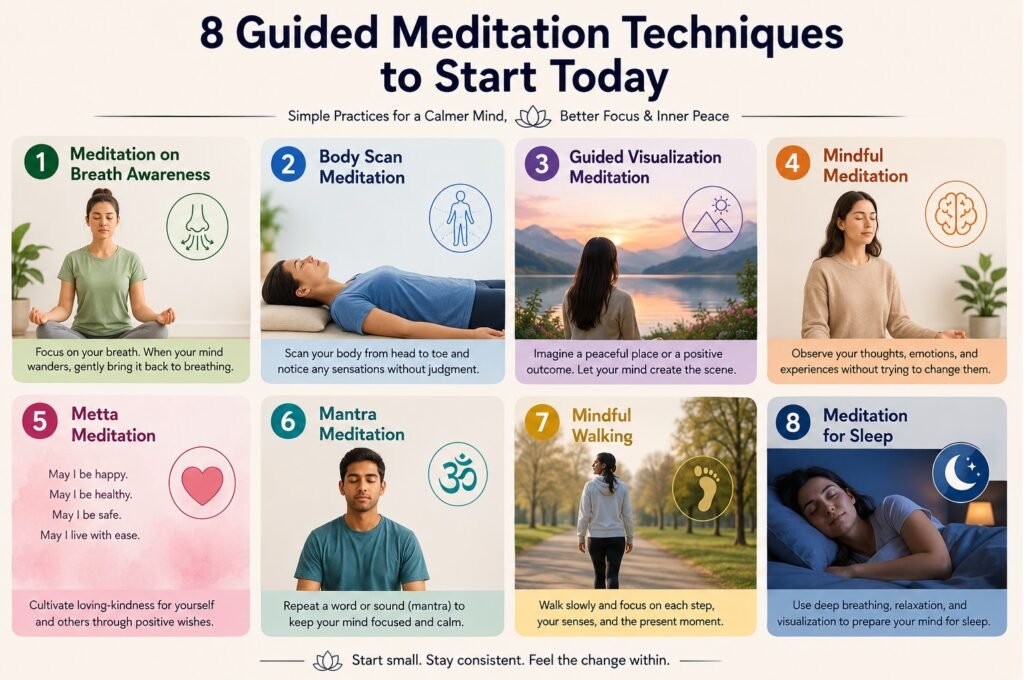
1. Meditation on Breath Awareness
This is meditation involving just your breathing process. Be relaxed while observing your inhaling and exhaling. In case your mind drifts, return your concentration to your breath gently. The University of Wisconsin research shows that breathing practices can help increase attention control skills and decrease stress. This is also one of the recommended meditation methods for beginners, considering it is easy and doesn’t require any prior experience.
2. Body Scan Meditation
Here in body scan meditation, you will scan the parts of your body from top to bottom and experience them without making any judgment on them. As per the findings by Mindfulness Journal, body scan techniques can ease the muscles and enhance the ability to sense stress signals through the body. It is also considered one of the best meditation types for relaxation.
3. Guided Visualization Meditation
Guided visualization meditation involves forming images of serene places or outcomes. The process often entails leading one into their imagination.
Sports psychologists have also come up with the notion that visualization practices can be adopted to boost confidence and performance. This is a method utilized by athletes, public speakers, and other professionals before important events.
4. Mindful Meditation
It is a type of meditation whereby one learns how to observe the thoughts, emotions, and experiences without making an attempt to change them. According to research conducted by Johns Hopkins University, this type of meditation is likely to reduce anxiety and depression symptoms among certain groups of people. This method makes one more aware of the present than focusing on the past or future.
5. Metta Meditation
Also known as Metta meditation, it is a type of meditation that cultivates loving kindness for self and others. Psychological science studies also suggest that loving kindness meditation is capable of enhancing joyfulness and social connections among people. This involves chanting some positive things about oneself and others.
6. Mantra Meditation
Definition of Mantra Meditation: Repeating words or sounds repeatedly to keep one’s mind attentive and focused on it.
Scientists found out that the repetition of certain words and sounds in meditation can help avoid distractions and increase concentration. Typically, such techniques imply repetition of words such as peace and calm.
7. Mindful Walking
All kinds of meditative practices may not suit all people. Mindful walking is when someone walks and meditates at the same time, focusing on their every move and step. As shown by scientific studies, mindful walking can improve the well-being of patients and reduce their stress levels. Moreover, it is beneficial for patients who have trouble meditating while being seated.
8. Meditation for Sleep
The purpose of sleeping meditation is to make a person feel more comfortable when going to bed. The meditation usually involves deep breathing exercises, physical relaxation, and creation of images in one’s mind. According to researchers at the University of Southern California, meditative sleep practices may be beneficial in improving sleep quality and reducing insomnia cases.
What Is the Best Meditation Technique for Your Goal?
| Goal | Recommended Technique |
|---|---|
| Better Focus | Breath Awareness |
| Stress Relief | Body Scan |
| Better Sleep | Sleep Meditation |
| Emotional Healing | Loving-Kindness |
| Confidence Building | Visualization |
| Daily Awareness | Mindfulness |
Time and again, studies prove that the best way to meditate is the method you can do regularly.
Traditional Meditation vs. Guided Meditation
Many newcomers ask which is the preferred strategy.
Traditional meditation usually needs self-guidance and prolonged concentration. Guided sessions provide systematic guidance to the practice.
Research suggests that beginner-guided meditation may increase adherence because it’s easy to follow. New meditators typically say they are less frustrated when they have some coaching than when they try to meditate by themselves.
Meditation for Digital Overload: The New Need of 2026
An aspect that was not covered in earlier pieces on meditation is that of technology overload. Individuals in modern society spend most of their time looking into gadgets, replying to texts and emails, and ingesting vast amounts of data.
Too many digital interruptions contribute to heightened stress levels and decrease productivity, say experts from the University of California. A fast kind of relaxation meditation designed to combat screen fatigue is gaining popularity.
A simple digital detox practice entails stepping back from one’s computer, taking five deep breaths, loosening the shoulder muscles, and listening to the sounds around oneself.
Signs That Meditation Is Really Working
People have high expectations about the results that will be achieved within a limited number of sessions, but it takes some time for the benefits to begin accruing from meditating.
Several studies suggest that with regular meditation, one may experience better sleep quality, improved emotional stability, reduced stress response, and improved concentration.
Signals of success: When one can bounce back from the challenges they face much quicker or even does not show strong responses to everyday stresses, then that may be considered a positive signal.
Guided meditation is always recommended to beginners because it aids them in achieving consistency in their practice.
Common Mistakes Made by Newbies
The first error to avoid while meditating is attempting to silence all your thoughts. Contrary to common belief, meditation does not involve silencing the mind, but it teaches you awareness of thoughts without attachment to them.
Secondly, it is erroneous to expect immediate results from meditation. The findings show that the benefits associated with meditation do not occur suddenly but become visible after a couple of weeks of practicing.
Most people who start with meditation choose durations that are too long. Experts suggest that most new learners should begin by meditating for about five to ten minutes daily.
Guided Meditation Session for 10 Minutes
To those who are new to meditation, here is an easy way to practice:
- First minute to two minutes: Focusing on breathing deeply.
- Third minute to fifth minute: Sense anything within your body.
- Sixth minute to eighth minute: Observe your thoughts without judgment.
- Ninth minute to tenth minute: Consider something you are thankful for.
Studies reveal that only ten minutes a day of meditation is sufficient to improve your mood, focus, and reduce stress levels. The most important thing during meditation is not the duration but consistency.
Future Research According to Meditation
Scientists take a closer look at meditation, beyond stress reduction. New research reveals potential benefits for cognitive health, emotional resilience, job productivity and healthy aging.
Scientists are also looking at how meditation may help brain plasticity, the brain’s ability to change and build new neural connections. There have been several studies reporting structural brain alterations in long-term meditators, especially in areas related to learning and memory.
As the study progresses, experts believe meditation will be an increasingly significant tool for mental fitness, as exercise is for physical fitness.
Final Thoughts
Guided meditation has moved from a niche wellness practice to a practical daily habit for millions of people across the world. Whatever your purpose, be it to relieve stress, sleep better, improve your focus, or just to attain emotional equilibrium, there is a form of meditation that will suit your lifestyle.
It’s not about the ideal technique. It’s about the practice.
Try beginning with a few minutes a day, experiment with different meditation techniques, and let the benefits build up gradually over time.
When practiced regularly, guided meditation is a simple yet potent way to achieve a more peaceful mind, increased concentration, and a healthier approach to the daily grind.