Obesity, diabetes, and metabolic syndrome are three commonly used terms when discussing health issues, with these three terms used interchangeably at times. But these are not all the same. In recent years, what has been changing is not only the prevalence rate of these diseases but also the patient profile. Some people are in their late 20s, with borderline high sugar levels, abdominal fat accumulation, and premature lipid metabolism abnormalities without any observable signs of the disease. As per the World Health Organization, reference material, the worldwide increase in obesity is more than double that of 1975. This trend had implications for the burden of type 2 diabetes and heart disease.
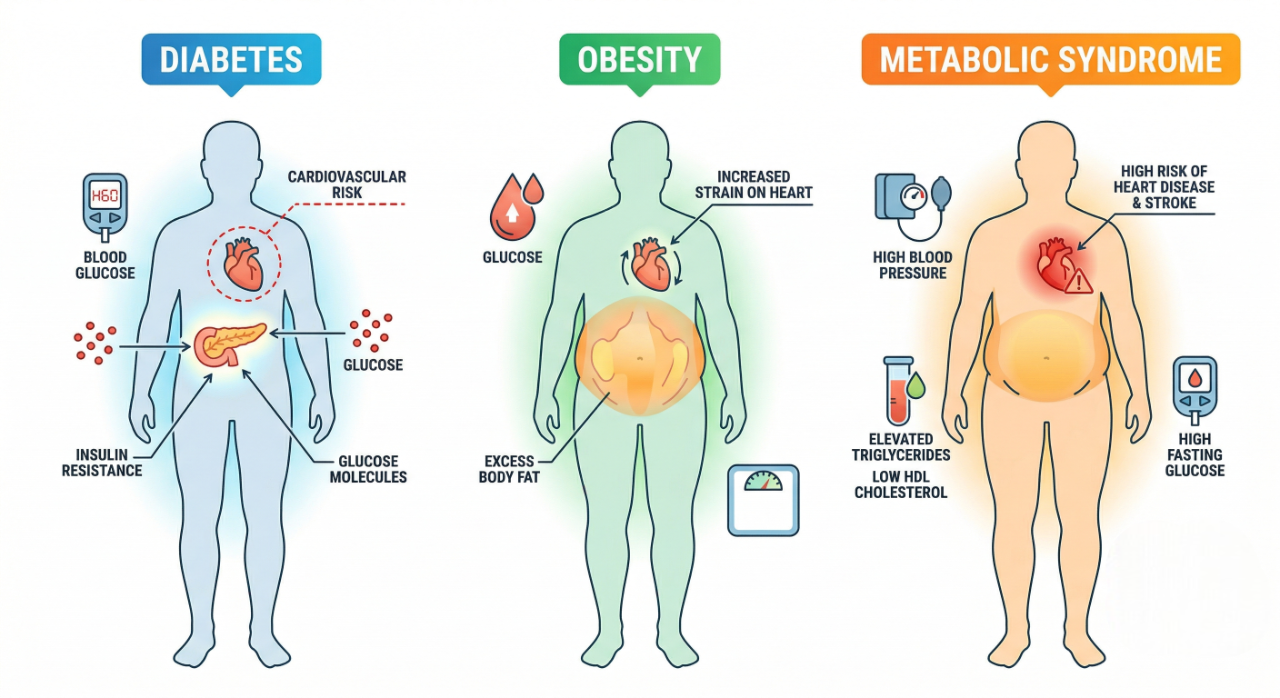
Obesity: More Than Just Body Weight
However, today, obesity is not diagnosed using just the weight. Rather, the key determinant of health risk lies in fat deposition. There could be an individual having a normal Body Mass Index (BMI) but with an elevated level of visceral fat. These fats deposit around the internal organs and are metabolically active in nature. They secrete substances that inhibit the action of insulin.
Numerous studies indexed in PubMed have proven the relationship between visceral fat and insulin resistance as greater than that of body mass index (BMI).
That is why the waist circumference is preferred by physicians nowadays.
The Indian people need less waist girth increase to develop metabolic risks.
Diabetes: A Disorder of Glucose Handling
Type 2 diabetes does not mean having high sugar only. It is a disease in which the organism becomes incapable of regulating its sugar levels adequately. It starts developing with the phenomenon known as insulin resistance. The pancreas attempts to make up for that by increasing insulin production. The initial stage usually passes unnoticed. People experience fatigue, hunger, and slight fluctuations in their weight, but do not pay any attention to these signs. According to the guidelines of the American Diabetes Association, people have difficulties in recognizing that they are sick for many years. The lack of early detection is one of the key factors in complications occurring later.
Metabolic Syndrome: The Overlap Zone
Metabolic syndrome should be considered a clinical syndrome rather than a disease entity.
This is established when several risk factors co-exist:
- Elevated fasting glucose
- Waist circumference
- Hypertension
- Hypertriglyceridemia
- Reduced HDL levels
Where Does the Confusion Come From?
The confusion between these conditions happens because they often exist together.
- Many people with high weight develop insulin resistance
- Some progress to diabetes
- Others fall into the category of metabolic syndrome without clear symptoms
However, not all individuals follow the same path.
There are also lean individuals with severe insulin resistance.
This variability is influenced by:
- Genetics
- Diet quality
- Physical activity
- Sleep patterns
This is why a one-size-fits-all explanation does not work.
What We Are Seeing More Often Now?
One trend that has been observed in recent times is that of metabolically obese, normally weighted people.
Such individuals are defined as those people who:
- Are normally within body weight
- Have a lot of visceral fat
- Are pre-diabetic
This issue becomes extremely significant when it comes to people of South Asian origin. Studies carried out in The Lancet indicate that the metabolic problems of South Asians are evident even at low BMI values.
Early Signs That Are Often Ignored
From the clinical point of view, the first symptoms are generally very mild.
The patient may complain about:
- Chronic tiredness
- Excess fat accumulation in the abdomen
- Weight gain that is difficult to lose
- Desire for carbohydrate-rich foods
Acanthosis nigricans is another symptom, characterized by hyperpigmentation in the folds of the neck and underarms. This symptom is often caused by insulin resistance. They are not alarming by themselves, which makes patients neglect them until abnormal test results are obtained.
Why Lifestyle Plays a Central Role?
In all three groups, lifestyle plays the greatest role. A sedentary way of life is characterized by low insulin sensitivity. Refined carbs and processed food cause increased spikes in glucose and fat deposition. One should also consider insufficient sleep. It leads to hormonal imbalance due to negative impacts on hormones like cortisol and insulin.
Clinically suggested methods include:
- Physical activity
- Healthy eating
- Enough sleep
All these factors have the potential to change metabolism significantly.
Can These Conditions Be Reversed?
It all depends on the particular situation. There is an easy way out in the case of obesity. Prediabetes may be cured. If you spot metabolic syndrome at its early stages, it can be easily controlled. But type 2 diabetes presents a completely different story. Although there are no promises, the good news is that some progress can be made. As it turns out, from clinical trials reported by the National Institutes of Health, the simple step of reducing your weight by 5-10% might help you in dealing with insulin resistance.
Another Perspective on the Matter
It is much more effective to view the problem from another angle, not separating these disorders.
- Obesity sets things off.
- Insulin resistance occurs.
- Blood glucose levels begin to increase.
- Risk factors start manifesting simultaneously.
At every stage, you can try intervening in the process. The sooner you do it, the better results you can expect.
What Should People Actually Do?
In other words, it is all about consistency.
The basic screening tests are:
- Fasting glucose test
- HbA1c
- Lipid profile
- Waist circumference
All this data gives much more precise results than just weight. Daily routine factors have priority over single-time events:
- Physical activities during the day
- Balance in nutrition with high content of proteins and fibers
- Consistent sleep schedule
There cannot be a “perfect” lifestyle. It is important to incorporate necessary changes consistently.
Sum up,
To begin with, it is crucial to mention that even though the mentioned diseases are various, all of them may lead to a metabolic disorder. The most complicated issue in medicine does not concern the treatment of any disease, but diagnosis. Moreover, there is another complication connected with one’s body type. One should consider that it does not show his/her state.