Quick Clinical Overview
Recognizing the early warning signs of Parkinson’s disease is vital for timely neurological management. Symptoms often begin subtly—such as a resting hand tremor, soft speech, micrographia, or slowed movements (bradykinesia)—and are frequently observed first by family members.
Sometimes the first person to discover a health condition is not the person who has it, but someone close to them. Someone in the family may observe that their parent is walking more slowly or the partner’s hands tremble at rest, or that someone has started speaking more quietly than previously. These changes may be confused with regular aging, weariness, or stress. But sometimes these are early symptoms of Parkinson’s disease. Parkinson’s disease is a degenerative neurological disorder that impacts mobility and other body processes. Symptoms normally develop slowly and are easy to notice in the beginning. Knowing parkinsons disease symptoms can help families identify odd changes and prompt their loved ones to seek medical advice at the appropriate time.
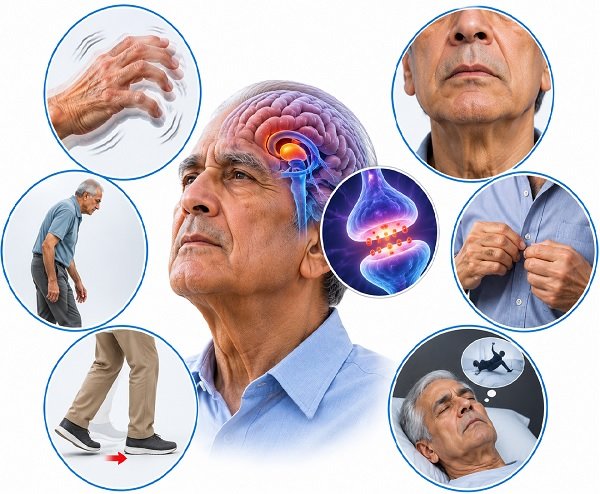
Parkinson’s disease is a movement illness that occurs due to the reduction in production of dopamine in the brain, says neurosurgeon Dr Deepak Agrawal. In this blog, we will highlight early warning indicators families should be aware of and when they should see a doctor.
What is Parkinson’s disease?
Parkinson’s disease is a neurological illness that affects particular nerve cells in the brain. These cells make dopamine, a neurotransmitter that helps control smooth, coordinated motions of the body.
When these nerve cells are gradually destroyed or cease to function properly, dopamine levels decline. This might cause symptoms such as tremor, muscle stiffness, sluggish movements, and balance issues. For more details on neural health, explore neurodegenerative diseases.
Dr. Deepak Agrawal says that it generally develops gradually and may first affect only one side of the body. Everyone does not have the same symptoms, and the speed at which the ailment progresses can also vary.
8 Warning Signs of Parkinson’s Disease in Family Members
Family members often see little changes before the person notices. Here are Eight Signs you should be aware of.
1. Slight Tremor in Hands or Fingers
One of the well-recognized early indicators of Parkinson’s disease is a tremor. You may see your loved one’s fingers, thumb, hand, or chin tremor slightly.
The shaking often occurs while the body portion is at rest or relaxed. For example, their hand could shake when sitting on a couch or holding it on their lap.
The shaking could start on one side of the body and gradually become more apparent. But not all hand tremors signify Parkinson’s disease. Some drugs, stress, and other medical issues might also induce shaking.
2. Small or Odd Handwriting
Did you see that one of your family members’ handwriting is smaller than it used to be?
Sometimes people with Parkinson’s experience an alteration termed micrographia. The letters become unusually small, congested or hard to read. Sometimes they will write while still writing smaller and smaller handwriting.
You might see it while they’re signing paperwork, writing shopping lists or scribbling notes.
If this shift is new and ongoing, it is worth discussing with a doctor.
3. Moving Slower When Performing Daily Activities
Someone with Parkinson’s might begin to take longer to do simple things. Your family member may take longer to button a shirt, get up from a chair, make meals, or walk across a room. Doctors name this slowness of movement bradykinesia. It is one of the key motor signs of Parkinson’s disease. Initially, families often attribute the change to the individual simply getting older and slower. But the noticeable difference in the speed of routine movements should not be dismissed.
4. Stiffness in the Arms, Legs or Shoulders
Muscle stiffness is another probable early indication. Your loved one may remark that their arms, legs, shoulders, or neck feel tight. You might also see that they do not swing one arm as naturally as the other as they walk. This stiffness might make things like getting dressed, turning in bed, or walking painful. It can also cause pain or restrict free movement for certain persons. Similar difficulties can occur with arthritis and other illnesses; therefore a medical assessment is required.
5. Alteration in Walking Pattern and Balance
Watch the way your family member walks. Are they walking in smaller steps now? One arm is closer to the body rather than swinging naturally?
Other possible changes:
- Taking small, shuffling steps when walking.
- It takes longer to turn around.
- Leaning forward while you walk.
- Problems with equilibrium.
- Feeling shaky or falling frequently.
These alterations may become increasingly apparent as Parkinson’s advances. It is crucial to undergo medical assessment for someone who keeps losing balance instead of taking it for granted as part of aging. For related movement difficulties, you can read about myelopathy symptoms.
6. Fewer Facial Expressions
Even when feeling normal, the individual with Parkinson’s may seem serious or emotionally detached. Their faces may expose less. They may blink less often or seem to have a fixed facial expression in conversation. This is also referred to as facial masking. Family members may observe that the person smiles less or does not have the same facial emotions as before. That doesn’t necessarily indicate they are miserable or depressed. This symptom may be added to by changes in the movement of the muscles of the face.
7. Voice or Speech Changes
Or have you started asking your family member to repeat what they say since their voice has gotten particularly soft?
Parkinson’s can damage the muscles used for speech. The person may speak less loudly, sound less expressive or have difficulties communicating clearly.
Some people may also talk in a more monotone voice or may have difficulty controlling how loud they talk.
Such changes can be slow, and family members may notice them before the person himself or herself.
8. Sleep Problems and Loss of Smell
Not all early indicators of Parkinson’s are motor. Some alterations can be seen years before movement issues become apparent.
Two instances are:
- Disrupted sleep: A person may talk, yell, or physically act out their dreams while they are asleep. This may be related to a condition called REM sleep behavior disorder. For general sleep science, check why sleep is necessary for humans.
- Diminished sense of smell: They may not be able to identify familiar aromas such as food, flowers, or spices.
Other non-motor symptoms can include ongoing constipation, anxiety, depression, and changes in thinking or memory.
These symptoms are caused by various things and on their own do not mean you have Parkinson’s disease. But any alterations that remain should be discussed with a health care expert.
How Do Family Members Differentiate Normal Aging From Parkinson’s?
Some of the symptoms of Parkinson’s can look like changes that are associated with aging. The main thing is to notice if a change is uncommon, permanent or progressively getting worse.
| Feature | Normal Aging Signs | Parkinson’s Indicators |
|---|---|---|
| Movement Speed | Slightly slower overall pace | Progressive slowness and difficulty initiating movement |
| Tremors | Rare, unless essential tremor exists | Distinct resting tremor in fingers, hands, or chin |
| Posture & Balance | Occasional stiffness after sitting | Shuffling gait, forward lean, and balance instability |
These discrepancies are general observations, not a diagnostic checklist. Only a medical specialist can determine if the symptoms are connected to Parkinson’s disease or another disease.
What to Do If You Notice These Signs in a Family Member?
If you detect one or more of these changes, don’t panic or try to diagnose the disease at home. Instead, take some actual steps.
- Note the changes: When did the symptoms begin? How often do they occur? Are they getting more prominent?
- Have a chat with your family member: Discuss the changes calmly. Do not make individuals feel frightened or ashamed of their symptoms.
- Observe particular examples: Write down changes in walking, writing, sleeping, speaking, or hand movements. These details can aid the doctor in diagnosing the problem.
- Schedule a doctor’s appointment: If changes continue or are of concern, see a neurologist. An expert can evaluate mobility, muscle stiffness, coordination, and other signs.
- Take them for follow-up visits: If diagnosed with Parkinson’s, regular visits to the doctor can help keep track of symptoms and modify treatment as needed.
Dr. Deepak Agrawal stresses the importance of knowing the symptoms and neurological changes in Parkinson’s disease. Getting medical counsel can help families understand what is happening and think about the right options for care.
How Do Doctors Diagnose Parkinson’s Disease?
There is no single test that can diagnose every case of Parkinson’s disease. Doctors frequently diagnose people by looking at their medical history, symptoms, and physical examination.
A neurologist may examine:
- Presence of a rest tremor in the person.
- How rapidly they can make simple movements.
- Whether their muscles are tense.
- The way they walk and balance.
- Whether the symptoms are on one or both sides of the body.
Sometimes the doctor will order brain imaging or other testing to exclude illnesses that can produce similar symptoms.
Getting an early diagnosis can help people understand what’s going on, and talk about treatment choices and managing symptoms. Dr. Deepak Agrawal says, “Parkinson’s disease may be hard to diagnose because the symptoms may come on slowly.”
Can Parkinson’s Disease Be Cured?
Today there is no cure for Parkinson’s disease, but there are several therapy choices to help control symptoms and assist with everyday tasks.
Treatment options may include:
- Medications: Some medications can boost or substitute for dopamine action in the brain, potentially helping to improve mobility.
- Physiotherapy: Exercises can help you maintain your movement, flexibility, strength, and balance.
- Speech Therapy: Can be helpful for those who have changes in voice, speaking, or swallowing.
- Occupational Therapy: A therapist can provide practical advice on making daily activities easier and safer.
Routine monitoring and follow-up appointments give doctors a chance to see how symptoms are changing and whether treatment needs to be adjusted.
Treatment depends on the patient’s symptoms, health, and the stage of the ailment. A neurologist can suggest a suitable care strategy.
To Conclude
The early signs of Parkinson’s are frequently subtle and may be hard to detect. Some of the first indicators a family could notice are a minor tremor in the hands, smaller writing, slower motions, stiffness, or changes in the way they walk. If families learn the symptoms of Parkinson’s disease they can recognize these changes without leaping to conclusions. One of these symptoms alone doesn’t guarantee someone has Parkinson’s, but if changes persist or worsen it’s a good idea to visit a doctor. Parkinson’s disease affects the brain’s ability to control movement and can lead to many changes in everyday life, says Dr. Deepak Agrawal. If you see any unusual changes in someone you love, encourage them to see a neurologist. Getting a timely medical evaluation can assist determine the problem and make sure they are getting the correct guidance and care.
Clinical Medical Review & Editorial Integrity
This medical content has been structured following strict medical journalism and expert verification frameworks to ensure absolute accuracy, trust, and safety in compliance with Google’s YMYL (Your Money Your Life) standards. For personalized diagnosis or neurological consultations, always consult a qualified neurosurgeon or neurologist.