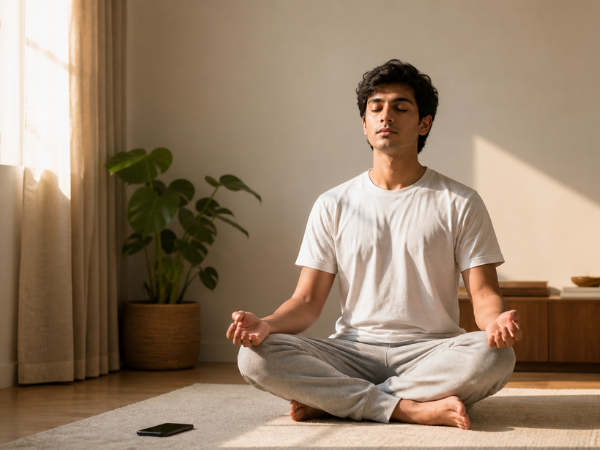
Meditation is an easy exercise that allows your mind to calm down and relax whenever the level of stress becomes unbearable. Meditation for stress relief is practiced across the world due to its calming effects on people’s lives. Stress meditation enables you to concentrate more on your breathing rather than allowing your mind to overthink about your future. This way, meditation for stress can help you have a better sleep cycle, decrease mental stress, and even react positively towards the challenges of life.
Why Is It So Difficult to Manage Anxiety in Today’s World?
Contemporary anxiety is different because, although it may not be obvious, it remains active on a subconscious level.
Namely, the mind continues to jump from:
Thoughts about the past (regret, mistakes)
Thoughts about the future (fear, pressure)
Never-ending notifications (messages, work, etc.)
As a result, our nervous system is constantly in a state of alert.
In the long term, that results in:
Insomnia
Overthinking
Anxiety spikes
Meditation can disrupt this pattern.
The Effects of Meditation on Your Brain
During meditation, you don’t “clear your mind,” but rather train your mind to react less instantaneously. Here are some of the things that happen:
Reduced stress response
Deeper breathing
Regular heart rate
Decreased feeling overwhelmed by thoughts
Improved emotional control
In essence, your brain is taught to wait rather than react out of panic.
5 Techniques That Will Really Help You Fight Stress & Anxiety
You don’t need to try all techniques. One alone will do the trick.
1. Breathing Meditation (Most Suitable For Beginners)
Just sit down and concentrate on your breathing.
If you get distracted, calmly bring your mind back.
No compulsion or pressure.
2. 4-7-8 Technique (For Instant Relaxation)
Breathe in for 4 seconds,
Hold for 7 seconds,
Breathe out for 8 seconds.
This immediately slows your nervous system, particularly in moments of anxiety.
3. Body Scan (Physical Stress Release)
Begin from the head and progressively scan down until you reach the toes.
Your body will have tense spots, and naturally, your body releases these tensions.
4. Grounding Technique (Anxiety Attacks)
Utilize the sense of touch:
5 things that you can see
4 things that you can feel
3 things that you can hear
2 things that you can smell
1 thing that you can taste
It instantly focuses your mind on the present.
5. Guided Meditation (Recommended for Newbies)
Guided by someone’s voice.
Beneficial if your brain is too busy to meditate silently.
What To Do In Case of a Sudden Anxiety Attack?
Sometimes, anxiety may overwhelm you suddenly, and it can be quite an overwhelming experience at the time. Knowing what to do when such a situation arises will assist you in gaining back control and decreasing the level of the attack.
In this case:
- Sit down where you are. Do not attempt to fight off the panic because doing so may make it even worse. Taking a brief pause enables your body to know that there is nothing to worry about. Breathe slowly. Try taking deep breaths rather than shallow ones. This will allow your heart rate to slow down.
- Take longer breaths when exhaling than when inhaling. For instance, take 4 seconds to inhale and 6 to 8 seconds to exhale. It is such a basic adjustment that triggers the body’s relaxation process by limiting the stress-induced “fight or flight” sensation.
- Apply the ground technique. Observe your surroundings and pinpoint objects that you can view, touch, hear, or feel. You will be able to redirect your focus from anxiousness to the reality of the moment. Only taking 2 to 3 minutes to carry out these measures could bring considerable benefits.
Meditation vs Breathing vs Grounding (Simple Difference)
They are sometimes confused, as they all have something to do with helping you relieve stress and anxiety, although they approach the situation differently.
Meditation → meditation for anxiety can be described as an ongoing process, training your brain to relax, avoiding overanalyzing things and gradually helping you restore emotional balance. In other words, it isn’t a one-time solution that works right away, but one that requires constant effort.
Breathing exercises → When it comes to stress relief through meditation, breathing exercises become extremely popular. They can quickly reduce anxiety as they instantly reset your nervous system due to their impact on slowing your heart rate.
Anxiety calmer techniques through grounding → used when a person suddenly panics. It helps to get the mind focused on senses such as vision, touch, and hearing, and this technique helps to feel secure once again.
The three mentioned techniques complement each other rather than compete with one another. Meditation is used to achieve calmness, breathing is utilized to alleviate stress peaks every day, and grounding is used for acute anxiety moments.