Most individuals find it difficult to adhere to a regular meditation practice, not because they aren’t interested in it, but because their schedules are already fully booked with numerous activities. Long working hours, endless notifications on their phones, and increasing screen time make it tough for them to relax. Behavioral science research on attention indicates that individuals’ levels of focus and concentration have sharply declined over the years, primarily due to excessive use of technology. This makes it increasingly difficult to begin meditating regularly and remain focused for at least a couple of minutes. However, recent scientific findings on habits also demonstrate that human beings tend to follow simple and easy-to-implement routines rather than complex practices. This is what most individuals do wrong – complicate their meditations instead of keeping things easy. The reality is that one doesn’t need to create an ideal environment for regular meditation.
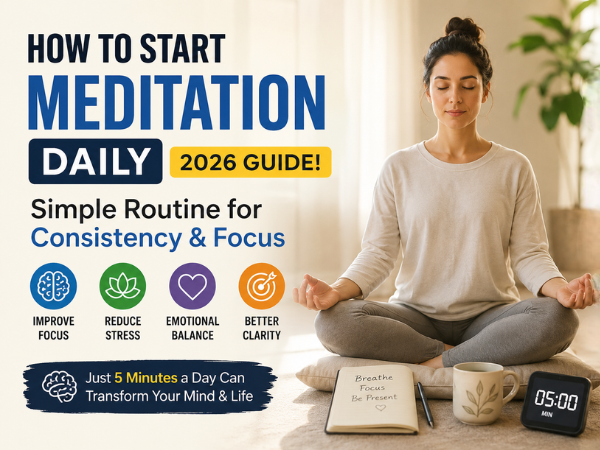
Why Daily Meditation Matters in 2026?
As of 2026, paying attention has never been more challenging due to numerous distractions such as notifications, multitasking, and scrolling endlessly through various pages. Research reveals that increased exposure to screen-based activities is associated with a decline in sustained attention and concentration among college students and working individuals. Thus, developing a regular meditation practice is crucial since it facilitates the recovery of the brain from stimulation and increases the capacity for focus regulation.
In addition to problems related to concentration and focus, stress and overthinking are becoming increasingly prevalent due to constant connectivity and mental availability. Cognitive psychologists emphasize that the use of smartphones and the multitasking mode can disrupt attention in a few seconds and result in cognitive overload, which triggers restlessness and anxiety. This creates a vicious circle of mental exhaustion that many find challenging to overcome.
However, attention research confirms that excessive screen exposure can affect the brain’s capability to pay continuous attention to any activity, particularly if an individual switches from one application to another or from one page to another quickly. Here comes the importance of cultivating a meditation habit.
The Importance of the Proper Mindset for Meditation
One of the main reasons for discontinuing meditation prematurely is the tendency to have unrealistic expectations. People often believe they should meditate in total silence, for long hours, and maintain an exceptional level of concentration right away. This kind of attitude produces stress, resulting in inconsistent practice.
Firstly, meditation does not involve the suppression of thoughts but rather the observation of thoughts without engaging with them. Once this concept is internalized, it is simpler to develop consistent meditation habits.
Secondly, a crucial shift in mindset involves being able to accept progress at a slower pace. As little as 2–5 minutes per day can yield substantial results if practiced consistently. Behavioral psychology terms this approach “low-friction habit creation.”
Source: Click here
Easy Daily Meditation Practice (For Beginners)
It is better to have a simple practice than a complicated one. The idea here is to make meditation part of your life rather than a process distinct from it.
Try meditating a couple of minutes every morning or evening, sitting comfortably and focusing on breathing while bringing your mind back to the practice when you notice it wandering. It does not have to be completely controlled.
The duration can gradually be increased once a daily practice becomes consistent. In meditation, consistency is more important than intensity.
Be careful not to try various techniques all at once when starting because stability allows the brain to adapt more quickly and develop concentration skills.
Scientific Research Result:
In studies on the effects of MBSR practices, it was discovered that even brief meditations on a daily basis lead to emotional regulation and attention control improvement over time (Clinical Psychology Review, 2025).
Some Typical Errors That Individuals Commit
One of the typical errors committed by those who are learning how to meditate is their belief that once they learn how to meditate, the technique will give immediate results, which, in case it fails, individuals assume that meditation is ineffective. Meditation requires persistence; thus, learners should practice for a certain period each day. A third mistake is the use of too many techniques within a short period. This makes individuals confused instead of helping them understand what meditation is all about. Sometimes, the simple way out is the best out.
Advantages of Meditating Daily
Meditation on a regular basis sharpens concentration, lowers stress levels, and promotes emotional stability. In the long run, it allows one to train their mind not to react to distractions.
Regular meditators have been observed to have greater clarity when making decisions, as well as higher-quality sleep.
Moreover, meditation helps lower the chances of overthinking by allowing the mind to remain focused in the present.
The main advantage of long-term meditation lies in greater self-control and not simply relaxation. That is why even business firms promote mindfulness training for their employees.
In addition, meditation aids productivity through improving mental concentration and consistency during work.
Research Finding:
Results from various mindfulness research projects prove that consistent meditators tend to demonstrate higher levels of attentiveness, reduced anxiety, and increased cognitive adaptability (National Institute of Health mindfulness reports, 2025).
Conclusion
Meditation is no longer simply a means to promote wellness; it is a powerful tool to handle the modern-day stress caused by information overload. Living in a world where distractions are abundant, being able to pause even for a short while can have a great impact. It doesn’t matter whether one becomes an adept meditator; the most important thing is to maintain regular practice.