Severe Facial Pain? How Gamma Knife Radiosurgery Cures Trigeminal Neuralgia
Imagine brushing your teeth, chewing food or just touching your cheek and feeling a sudden electric jolt in your face. If you have Trigeminal Neuralgia, these simple everyday things might be very uncomfortable. The pain may last for a few seconds but may recur many times over the day and make normal life difficult.

Trigeminal Neuralgia is a nerve-related illness which causes abrupt acute pain in the face. Medicines are often the initial step in treatment although they may not work for everyone. Some people may develop negative effects or the drugs may become less effective over time. Gamma Knife Radiosurgery can become an essential therapy option here. It treats the trigeminal nerve with targeted radiation and does not require standard open surgery.
But how does this treatment work? Can it really relieve acute pain in the face without making a cut on the face or opening the skull? Let’s understand the illness and its treatment choices. For related neurological insights, you can also explore understanding headaches and common triggers.
What does trigeminal neuralgia mean?
Trigeminal neuralgia is a disorder of the trigeminal nerve, the nerve that conveys feeling from the face to the brain. We have two trigeminal nerves, one on each side of the face. Each neuron has branches that relay sensations from places like the forehead, cheeks, jaw and teeth. It normally affects one side of the face but can sometimes affect both sides. The pain can last a few seconds or more and may recur in episodes.
What Causes Trigeminal Neuralgia?
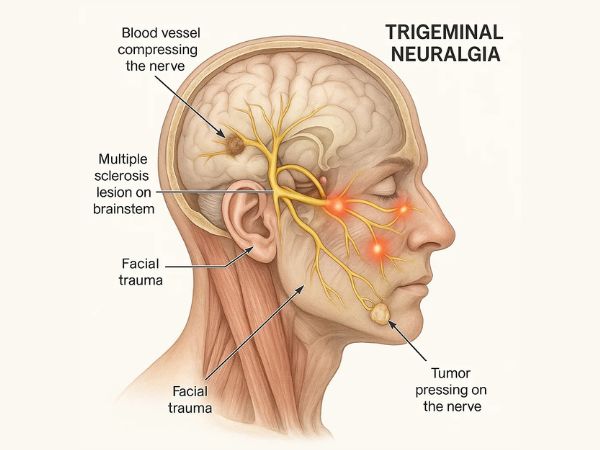
One typical cause of Trigeminal Neuralgia is pressure on the trigeminal nerve by a neighboring blood vessel. This pressure can cause damage to the protective covering of the nerve – called the myelin sheath.
Other possible causes are:
- Multiple Sclerosis (MS): This disease can damage the protective layer that surrounds nerves and may harm the trigeminal nerve.
- Tumors: Sometimes, a tumor situated near the trigeminal nerve can impinge on it.
- Nerve injury: The nerve may be damaged by an injury or certain medical procedures.
- Unknown causes: Sometimes, doctors can’t uncover a clear reason for the ailment.
The cause is not the same in all patients. An MRI scan and a medical checkup can help doctors identify what may be damaging the nerve.
What Are the Common Symptoms?
Trigeminal Neuralgia can produce considerable discomfort even with a relatively light touch on the face. Common symptoms are:
- Sudden, acute or electric-shock type pain on one side of the face.
- Pain lasting from a few seconds to a few minutes.
- Pain during biting, talking or brushing teeth.
- Discomfort when washing your face or putting on make-up.
- Pain attacks during the day.
- Pain in the jaw, cheek, teeth, forehead or eye area.
Some people have periods of pain-free time between attacks, while others have regular episodes that disrupt their sleep, eating habits and daily routine.
It is crucial to get a good diagnosis because dental disorders and other facial pain conditions can have similar symptoms.
How Is Trigeminal Neuralgia Diagnosed?
Generally, doctors diagnose Trigeminal Neuralgia by studying the pattern of the pain of the patient and checking the nerve system.
The assessment can include:
- Medical History: The doctor inquires about the location, length and nature of the discomfort. They may also question what activities bring it on.
- Neurological Exam: The clinician evaluates facial feeling and other nerve functions for evidence of nerve involvement.
- MRI Scan: An MRI helps doctors see the trigeminal nerve and adjacent blood vessels. It can also help to discover illnesses such as tumors or Multiple Sclerosis that may be causing the symptoms.
What Are the Treatment Options for Trigeminal Neuralgia?
Treatment usually begins with medication. But if drugs don’t give enough relief or have hard-to-take side effects, doctors may consider additional operations. Some of the common treatments are:
1. Drugs
Medicines are usually the first treatment for trigeminal neuralgia. They may also prescribe some drugs to suppress aberrant nerve signals. These may be carbamazepine or oxcarbazepine.
Other medications may be used based on the patient’s condition. These drugs should be taken only under medical supervision as they may have negative effects and may need regular monitoring.
2. Microvascular Decompression (MVD)
Sometimes there is a blood vessel pressing on the trigeminal nerve which causes discomfort. In these instances doctors may suggest a Microvascular Decompression. In this procedure, the surgeon creates an incision behind the ear and carefully pulls the blood vessel away from the nerve. The MVD attempts to decompress the nerve without purposely injuring it. It can give long-term pain relief in the right people, but it’s a big operation and requires general anesthetic.
3. Rhizotomy Procedures
Rhizotomy techniques try to relieve pain by purposely altering part of the nerve fibers that transmit pain signals.
Different ways that can be employed include:
- Radiofrequency Therapy
- Balloon occlusion
- Injection of Glycerol
These procedures may be helpful to individuals who are not getting adequate relief from drugs. But they can also induce numbness of the face or altered sensation.
4. Gamma Knife Radio-Surgery
Another alternative for selected patients with Trigeminal Neuralgia is Gamma Knife Radiosurgery. It uses a very focused beam of radiation to treat a specific area of the trigeminal nerve.
There is no need for a hole in the skull or a cut on the face like typical surgery.
How Gamma Knife Radiosurgery Works?
The name Gamma Knife may sound like a surgical equipment, but it doesn’t employ a knife or blade at all.
It is a type of Stereotactic Radiosurgery (SRS). In this approach, numerous beams of concentrated gamma radiation are aimed at a small target near the trigeminal nerve.
Each beam travels through surrounding tissue, but the therapy is tailored to concentrate the radiation dose in the chosen target. This radiation affects the nerve’s conduction of pain impulses, and over time the pain is diminished.
The alleviation isn’t always immediate. Some individuals see an improvement within a few weeks, others take several months before they may feel the full effect.
The particular response depends on the patient’s condition and treatment approach.
What is it like to undergo a Gamma Knife procedure?
Gamma Knife is typically performed on an outpatient basis. Most individuals do not require a prolonged hospital stay.
The steps usually involve the following:
- Patient Evaluation: The doctor reviews the patient’s medical history, symptoms and MRI scans to see if Gamma Knife is appropriate.
- Head Positioning: During treatment, a light head frame or tailored mask may be used to keep the head in the right posture. With a frame, local anesthetic is given at the points of connection.
- Imaging and Treatment Planning: MRI or other scans as needed by doctors to determine the exact treatment area. Then special software is used to plan the dose and target of the radiation.
- Radiation Treatment: The patient is placed on the treatment couch, and the Gamma Knife machine delivers focused radiation to the target area. You can read more via artificial intelligence in gamma knife treatment. The patient cannot feel the radiation rays.
- Completion and Recovery: Once therapy is finished, the frame or mask is removed as appropriate.
How successful is Gamma Knife for Trigeminal Neuralgia?
Gamma Knife can offer considerable pain relief for many patients, but not all patients will experience the same benefits. A review of Gamma Knife treatment for Trigeminal Neuralgia found that up to 69% of patients in the studies it reviewed were pain-free without medication at one year. The rate at three years was lower, indicating that discomfort can recur with time.
It is also vital to note that it may take weeks or months for discomfort to subside. Some people may still need medications at this time.
Factors such as these can influence the outcome:
- The type and duration of the Trigeminal Neuralgia.
- Location of the target of radiation.
- Past operations and treatments.
- The general health of the patient.
- The therapy dose and manner of planning.
Gamma knife is thus a therapeutic option and not a guaranteed cure. Doctors talk about the prospective benefits and hazards and recommend it.
Possible Side Effects?
Gamma Knife is not an open surgery in the classic sense, although there can be side effects.
Numbness or a change in sensation in the face is one of the most commonly reported adverse effects.
Other potential impacts include:
- Mild headache or pain following treatment.
- Changes in sensation in face which occasionally may be long lasting.
- More serious nerve-related problems (rare).
Risk depends on the treatment approach and patient’s health.
Who Is Suitable for Gamma Knife Treatment?
- Medicines do not work adequately to relieve pain.
- Have trouble with adverse effects of drugs.
- Other health issues make big surgery a poor option for them.
- Have Trigeminal Neuralgia that has come back after previous treatment.
Gamma Knife, however, is not the best choice for every patient. The final decision depends upon the reason of pain, MRI findings, past therapies and health of the patient.
Dr. Deepak Agrawal explains Gamma Knife Treatment
The right treatment for Trigeminal Neuralgia is dependent on a correct understanding of the nerve, the origin of the pain and the patient’s physical state.
Neurosurgeon Dr. Deepak Agrawal discusses the function of Gamma Knife Radiosurgery in treating this ailment. For patients wanting to learn more about general healthcare awareness, you can check health tips and awareness guide.
An skilled specialist can assist patients realize if medications, Microvascular Decompression, Rhizotomy or Gamma Knife is the correct solution for them.
Final Thoughts
Simple activities such as eating, talking and brushing your teeth can be quite difficult with Trigeminal Neuralgia. But there are therapy choices for patients, and the appropriate approach can significantly improve quality of life. For chosen people, Gamma Knife Radiosurgery is a less intrusive approach. It does not require standard open brain surgery and can ease pain by focusing radiation at the trigeminal nerve. But the relief may take time, discomfort may recur and face numbness is a possible side effect. The key is to acquire an accurate diagnosis and to explore all appropriate treatment options with a skilled neurosurgeon.