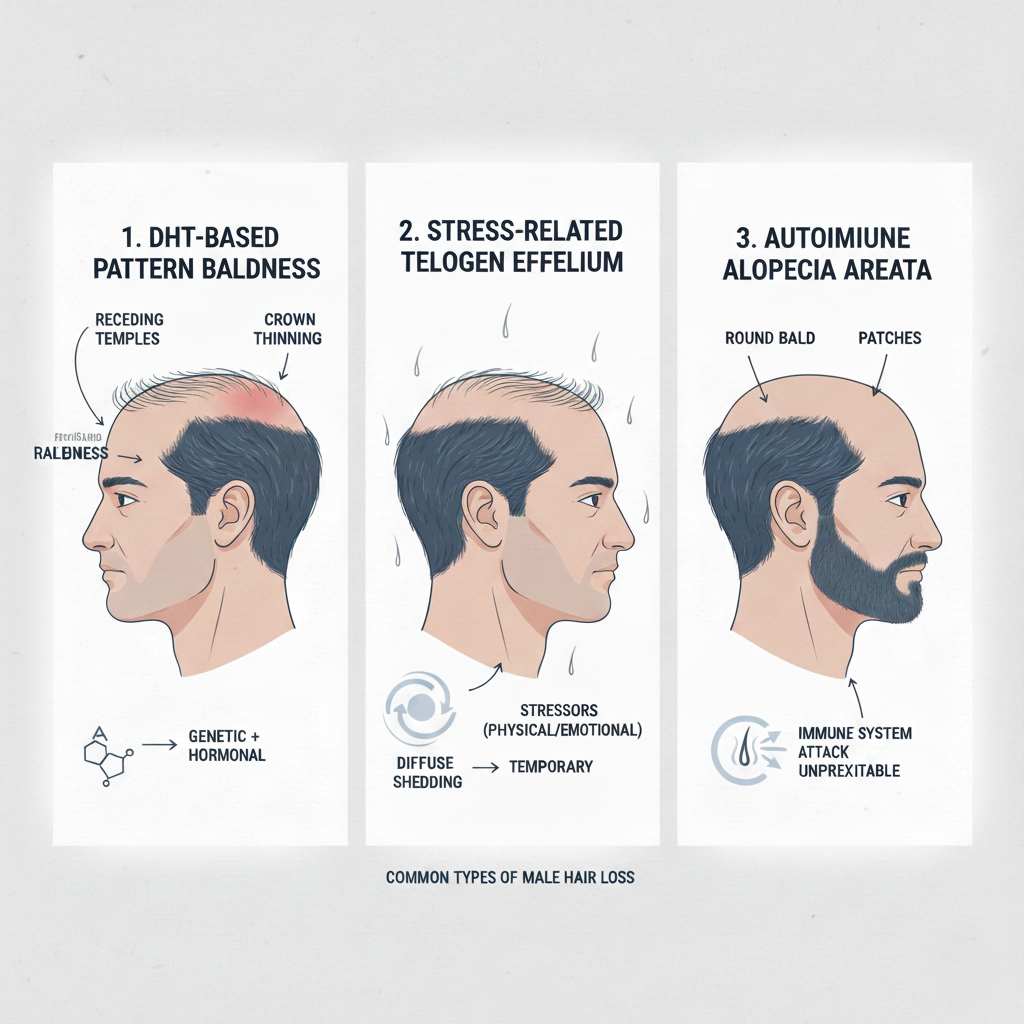
Hair fall is a very common problem; more than 50% of men start developing it before they turn 50 years old. Basically, hair fall is caused by three fundamental reasons: DHT-based pattern baldness, in which a hormone known as DHT makes the hair thin and weak over time; stress-related hair fall, which occurs when sudden stress pushes a lot of hair into falling out at once; and autoimmune hair loss, when the body’s immune system itself mistakenly attacks hair roots and causes small round bald patches.
This 2026 guide explains in simple words the various kinds of hair loss. It also talks about why hair falls happen, what signs you should notice, and what new treatment options are coming up. Most people know about just two common medicines, finasteride and minoxidil; now, there are more treatments being researched.
Core Hair Loss Types
Most hair loss comes about in three simple ways, and once you learn them, it gets much easier to figure out what type you might have. The first and most common is DHT-driven androgenetic alopecia. Here, a hormone called DHT attaches itself to the roots of your hair and makes them progressively smaller and weaker. For this reason, your hair will start to thin out over time, particularly around the temples and at the crown of your head. This type of balding is gradual and continuous in nature; many men begin to recognize the first signs in their late 20s or early 30s.
The second type of telogen effluvium is stress-induced. When the body undergoes tremendous stress-such as illness, surgery, emotional shock, and/or sudden weight loss-its secretion of cortisol increases. This can push a lot of the hair strands into the “resting” stage. After about 3 to 6 months, these hairs fall out all at once and cause overall thinning. The good thing is that this is usually temporary once the stress is handled.
The third is autoimmune alopecia areata. In this condition, the body’s immune system mistakenly attacks the hair roots. Thus, on the scalp or beard, small, round bald patches appear. It mainly appears quite suddenly and may grow or shrink without warning.
These three types cover most of the cases and give guidance on proper treatment.
Hair Growth Cycle Essentials
Hair grows in a cycle of three main phases: anagen is the phase of growth, which generally lasts 2-7 years; catagen, a short transition phase when growth ceases; and telogen, the resting phase, which lasts about 3 months before the hair falls out. These phases are disrupted in different ways by various types of hair loss. In DHT-driven hair loss, the anagen phase is shortened, so your hair gradually thins over time. Stress-related hair fall prolongs the telogen phase, with many hairs then suddenly falling out a few months after the initial trigger. Autoimmune hair loss results in growth coming to a complete stop in those areas where the immune system directly attacks the follicles.
Doctors are able to deduce the kind of hair loss by making examinations such as the pull test, dermoscopy, or sometimes a biopsy to determine which phase and follicles are affected.
Comparison Table: Types of Hair Loss
| Aspect | DHT / Androgenetic | Stress / Telogen Effluvium | Autoimmune / Alopecia Areata |
| Pattern | Crown & temples | Diffuse shedding | Patchy bald spots |
| Onset | Gradual, usually after age 20 | Sudden, 3–6 months after stress | Rapid, can occur at any age |
| Reversibility | Partial with early treatment | Often full if trigger resolves | Variable; may relapse |
| Key Trigger | Genetics + DHT | High cortisol / trauma | T-cell immune attack |
This table helps in quickly seeing the differences in identifying which treatment might work best.
Standard Treatments
Most of the popular hair loss treatments target the major causes. Finasteride works by blocking DHT, which is the hormone responsible for the shrinkage of hair follicles. Studies show it can reduce scalp DHT by about 64%, slowing or stopping hair loss. Minoxidil increases blood flow to the scalp and expands the period of growth-anagen phase helps keep hair thicker for longer. As treatments available work well with different types of hair loss, some may experience a few side effects, such as reduced libido, occurring in 2% cases. The use of finasteride, combined with minoxidil, could amplify their results, with studies showing the regrowth of hair up to 94%. It is here that adding therapy and better sleep will help in further recovering from stress-related hair loss.
Overlooked Emerging Therapies 2026
New treatments are showing promise for a variety of hair loss that go beyond the standard options. PP405 topical works on dormant follicles through its effects on mitochondria. Phase 3 trials showed that 31% of men with DHT hair loss had gained over 20% hair density by week 8. Sublingual minoxidil, or SAM-002, has completed Phase 3 trials and is better tolerated for pattern baldness. Microneedle patches and JAK inhibitors are useful for autoimmune alopecia areata through immune system modulation by increasing T-reg cells. Last but not least, topical dutasteride 0.05% has been found to be superior to oral finasteride in improving hair count and thickness.
These emerging options bring new hope for more effective, safer, and more targeted hair restoration in 2026 and beyond.
Gaps in Nutrition and Lifestyle Not Addressed
What a person eats and the way they live can make a big difference in hair health, which is often overlooked. Certain foods naturally act to lower levels of DHT, the hormone linked to pattern baldness. Green tea, for example, contains the active ingredient EGCG, an inhibitor of DHT production, while pumpkin seeds provide necessary nutrition to the hair follicles, and turmeric reduces scalp inflammation. An anti-inflammatory diet will reduce stress-related shedding, thus soothing the body.
Certain medicines or supplements also result in hair fall. For instance, GLP-1 agonists, such as semaglutide, have been found to increase telogen hairs, which results in temporary shedding.
Equally, the aspects of lifestyle are no less important. Walking 15,000 steps daily, dumbbell/resistance training, and good sleep would help improve scalp circulation and reduce stress hormones. Monitoring by apps may help reach consistency.
Proper nutrition, daily activity, and stress management can enhance the treatment effects of finasteride, minoxidil, or other emerging therapies by taking care of your hair from the inside out. After all, small changes make a big difference over time.
Prevention & Diagnosis Tips
The earlier the diagnosis of hair loss, the better. Genetic testing can suggest if you are at a higher risk for developing DHT-driven pattern baldness and may therefore allow you to make plans for precautionary measures. If there is autoimmune hair loss, confirmation that your immune system is attacking the follicles can be obtained by a scalp biopsy.
The onset of this treatment is important before the age of 30 years because research has shown that early intervention can save up to 80% of hair follicles. It is also assisted by regular monitoring of thyroid levels and stress hormones since imbalances may worsen shedding. Other preventative measures include minimizing triggers such as high stress, poor sleep, or inflammation. Sticking to a healthy diet and an active lifestyle will also help. Watching hair patterns through photos or simple scalp checks can warn you of early thinning. Early diagnosis, combined with lifestyle modification and proper treatment, can significantly improve the chances of a person’s hair remaining healthy, thick, and strong for a longer period.
Frequently Asked Questions
- Does diet help reverse DHT-related hair loss?
Diet can help to a certain extent. Green tea, pumpkin seeds, and turmeric are said to lower scalp levels of DHT by inhibiting the enzyme 5-alpha reductase. Diet alone cannot complete the reversal of hair loss; it works best when associated with treatments such as finasteride or minoxidil.
- How quickly can I expect medications like finasteride and minoxidil to take effect?
Most people see visible improvement in 3–6 months, though the full results can take up to a year to manifest. More often than not, a combination of both treatments yields better results.
- Is there any possibility of hair growing back after stress-induced hair loss?
Yes, telogen effluvium because of stress is temporary. Hair grows back within 3–6 months after stress management and an improvement in sleep, nutrition, and lifestyle.
- Are emerging 2026 therapies more effective?
Early studies are showing that new options, including PP405 topical, sublingual minoxidil, microneedle patches, and topical dutasteride, may give 20–30% superior hair regrowth to existing treatments, with improved safety and tolerability.
- How can I prevent hair loss early?
Early prevention includes genetic testing for risk of DHT, monitoring thyroid and stress hormones, a healthy diet, regular exercises, and commencing the treatment well in advance of significant hair thinning-ideally under age 30-to preserve up to 80% of follicles.
Sum up
Many people experience hair loss, but it is vastly different when one knows the type involved, its cause, and the options available for treatment. The year 2026 brings a host of choices for the first time, ranging from well-known finasteride and minoxidil to new therapies such as PP405 topical, sublingual minoxidil, microneedle patches, JAK inhibitors, and topical dutasteride. Many of the newer options have promising results, sometimes improving hair regrowth by 20-30% over standard treatments, offering better tolerability, and targeting different causes-DHT, stress, or autoimmune attacks. Early diagnosis is the key. Genetic testing, scalp biopsies, and monitoring thyroid or stress hormones can also help in identifying risks and guide treatment.
In addition, lifestyle and nutrition play an important part. DHT-reducing food intake, anti-inflammation diets, stress management, walking, and strength training help in maintaining hair health and supplement medical treatments. Due to the great variation in hair loss from one individual to another. Personalized care stands out as the best approach. A consultation with a dermatologist or hair specialist will make sure your care plan caters to your hair type. Cause of loss, age, and overall health. Combining traditional treatments with the emerging 2026 therapies, besides proper nutrition and good lifestyle habits, ensures the highest chance of keeping existing hair intact and its regrowth. With early action and proper guidance, one is able to keep healthier and thicker hair for many years to come.