If you have a brain tumor and are told you need radiation therapy, you may hear different names for it, such as Gamma Knife, CyberKnife, and Proton Beam Therapy. All three use state-of-the-art technology to target bad cells, but they don’t all work in the same way. This often makes people think: Which one is better? The answer depends on what you are treating. The Gamma Knife is mainly used to treat problems in the brain and some of the areas around it. CyberKnife can treat some brain, spine, and other tumors in the body. Proton beam therapy is another type of radiation that can be helpful to doctors when they want to limit the amount of radiation that reaches nearby healthy tissue.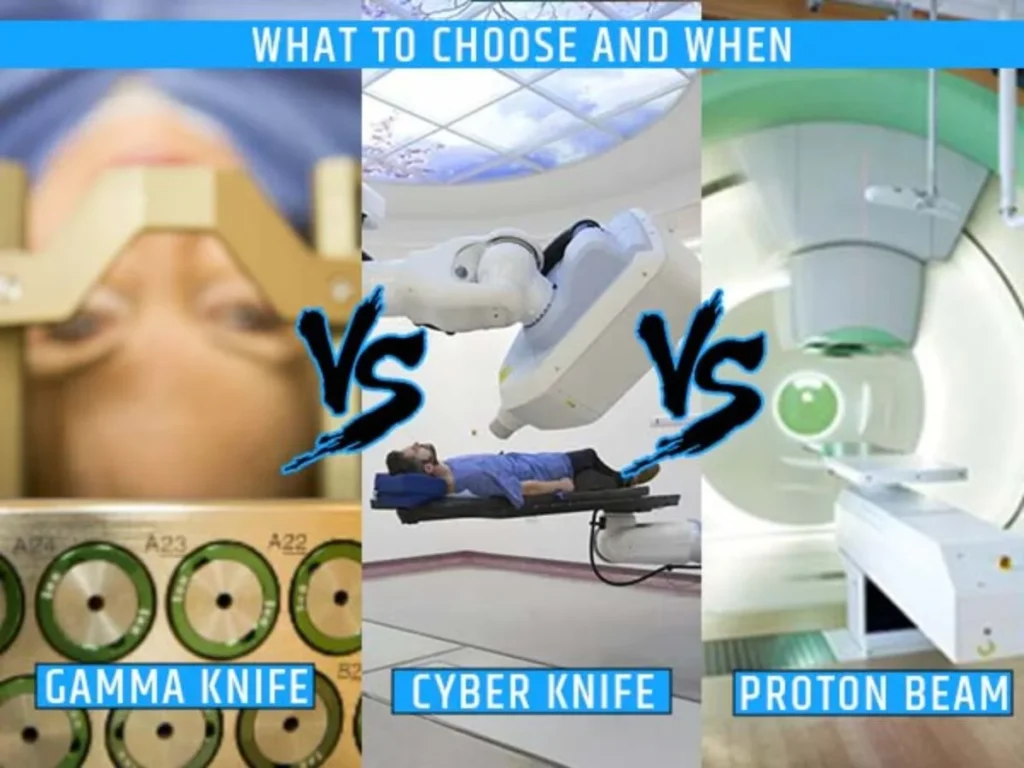
This is not a question of three machines in terms of neurosurgical treatment. You really need to know the patient’s diagnosis, the results of the scan, the size of the tumor, the location, and the goals of treatment. Let’s take a look at what makes these treatments unique and how they work. You can also explore more insights on health tips and awareness guide for better patient care.
Understanding the Difference Between Gamma Knife, CyberKnife and Proton Beam
This is important to know before comparing them: radiosurgery does not mean the doctor is cutting something with a knife. Stereotactic radiosurgery (SRS) is a type of radiation treatment for cancer. The computer makes plans and does detailed scans to send a high dose of radiation to a specific area. The aim is to damage the targeted cells but to shield the surrounding healthy tissue from undue radiation. The Gamma Knife radiosurgery is one technology used for this kind of treatment. Another is the CyberKnife. Another type of radiation treatment is Proton Beam Therapy. This treatment uses protons, or charged particles.
The difference is the type of radiation used and how it gets to the target.
What is Gamma Knife radiosurgery?
Gamma Knife is a type of radiation system that is used mainly to treat some conditions of the brain. It’s not what you think. No cutting blade, no opening the skull. A lot of small beams use Gamma radiation. All these beams converge at a predetermined point in the brain, delivering a high dose of radiation to that point. Each beam goes through healthy tissue on its way to the target. The treatment plan is designed to deliver the main dose of radiation at the point where the beams intersect. Current Gamma Knife systems use MRI or CT imaging to locate the target. The treatment team uses these pictures to decide on the dose and to make sure that as many surrounding structures as possible are safe.

What can Gamma Knife fix?
In some cases, Gamma Knife may be offered:
- A meningioma is a tumor that develops from the membranes that surround the brain. For more complex cases, you can read about parasagittal and parafalcine meningiomas.
- An acoustic neuroma is a non-cancerous growth on a nerve that helps with balance and hearing.
- There are tumors in the brain that have metastasized from other parts of the body where the cancer was.
- These are particular kinds of growths that form in the pituitary gland .
- Arteriovenous malformations (AVMs) are when the arteries and veins in the brain don’t connect properly.
- Trigeminal neuralgia causes you to have a sudden, severe pain in your face, which can also be managed via Gamma Knife radiosurgery for trigeminal neuralgia.
Sometimes Gamma Knife doesn’t work the same way. That is, if used on a brain tumor, the intent may be to stop or slow tumor growth. Finally, it’s an AVM that’s going to block the strange blood vessels over time. The goal in treating trigeminal neuralgia is to stop the nerve from sending pain signals. For comprehensive neurological procedures, you can review brain tumor removal surgery techniques.
What Are the Main Benefits of Gamma Knife?
The biggest advantage is that it does not require an open cut for surgery. It can deal with some brain lesions that are small or well-defined, even lesions that are difficult to reach with open surgery. Treatment can often be done in one session. Some patients may require more than one session or a different treatment plan if the target is large or located elsewhere. However, the Gamma Knife is not always the best option for brain tumors. For example, you may first have surgery or another treatment if a large tumor is pressing on the brain. You can learn what to expect before and after brain surgery to better prepare.
What is CyberKnife treatment?
CyberKnife is a robotic cancer treatment system. Photons, high-energy X-rays, are used to target tumors and other abnormal areas. CyberKnife, in contrast, has a robotic arm that circles around the patient and shoots radiation from many angles. Imaging is also used to confirm the position of the target during treatment.
This allows the system to adjust the amount of radiation being delivered to the target or patient if they move a little. This feature is particularly useful when treating areas of the body that move when you do normal things like breathing.
What diseases can CyberKnife treat?
The CyberKnife can be used for selected conditions in different parts of the body, such as
- brain tumors
- metastases in the brain.
- types of spinal tumors
- lumps in the lungs.
- Certain prostate cancers.
- Tumors of the liver and other parts of the body.
How it is used depends on the type of tumor, its size, and its location. “Sometimes CyberKnife can’t remove tumors, so the radiation oncology team will have to review the treatment plan. You can also explore cancer treatment alternatives and general oncology awareness on World Cancer Day insights.
What Makes CyberKnife Different?
This is because the robotic arm allows the radiation to be delivered from different angles. Other systems require the machine to rotate around the patient. CyberKnife is also known for its ability to track motion and treat conditions with pictures. This can help doctors treat some tumors in places where they need to be careful about very small movements. Treatment is generally spread over more than one session, with the exact number of sessions required depending on the condition and treatment plan.
What is proton beam therapy?
Proton beam therapy is a kind of cancer treatment that uses positively charged particles, called protons. Machines called cyclotrons and synchrotrons accelerate the particles and aim them at the tumor. In proton therapy, the energy is released in your body differently than with X-rays. X-ray beams pass through the tumor and through the tissue beyond. At some depth protons can be told to give up most of their energy. This is known as the Bragg peak. By now the protons have lost most of their energy and have come to a halt. This can reduce the amount of radiation that reaches healthy tissue outside the target. This can be a useful characteristic if the tumor is near a sensitive structure, such as the brainstem, eyes, or important nerves.
When and how do you use proton beam therapy?
Proton therapy can be used to treat certain cancers and tumors, such as:
- Some brain and skull base cancers.
- Some spinal tumors.
- Types of childhood cancer.
- For selected head and neck cancers.
- Some tumors are found near very important tissues or organs.
It may help if the people treating the cancer think that lowering the dose of radiation to nearby healthy tissue could make a big difference. But X-ray-based radiation is not always better than proton therapy for all patients. The advantage depends on the type of tumor, the plan for treatment, and the medical evidence that currently exists. For deeper understanding, you can read about Gamma Knife, proton beam, or Cyber Knife comparisons.
Gamma Knife vs CyberKnife vs Proton Beam: A Detailed Comparison
Although all three treatments use advanced radiation technology, their methods and areas of use are different.
| Feature | Gamma Knife | CyberKnife | Proton Beam Therapy |
|---|---|---|---|
| Type of radiation | Gamma rays | X-rays (photons) | Proton particles |
| Main treatment area | Brain and selected nearby areas | Brain, spine and selected body areas | Selected cancers in different body areas |
| How it works | Many focused beams meet at the target | Robotic arm delivers beams from different angles | Protons release most of their energy at a planned depth |
| Treatment sessions | Often one session; sometimes more | Usually several sessions | Usually a course of sessions |
| Imaging and planning | Detailed brain imaging and computer planning | Image-guided treatment and motion tracking | Detailed imaging and proton dose planning |
| Main strength | Focused treatment for selected brain conditions | Flexible delivery for selected tumours in different body areas | Can reduce radiation beyond the target |
| Important limitation | Mainly designed for targets in or near the brain | Not suitable for every tumour or body movement | Limited availability and high treatment cost in many settings |
There is no single winner in this comparison. The best option is the one that gives suitable tumour control while keeping the risk to healthy tissue as low as reasonably possible.
Which Treatment Is Better for Brain Tumours?
This is a question often asked by patients and their families. That will depend on what kind of brain tumor it is and what the doctor wants to do. You can check brain cancer types, symptoms, and causes to understand various diagnoses.
When You Might Need a Gamma Knife
Gamma Knife may be used for some small or well-defined brain tumors such as meningiomas, acoustic neuromas, and metastases in the brain. You can also review atypical meningioma details for more specific clinical presentations.
It may also be used if the tumor is in a location that cannot be reached or if the patient is not a good candidate for open surgery.
When is CyberKnife used?
A person might consider CyberKnife for stereotactic radiation of a specific brain or spinal tumor. It can also treat other tumors in the body. You can also explore options like glioma causes, symptoms, and treatments.
Image-guided system and robotic delivery can be helpful when close monitoring is needed in the treatment area.
When You Might Want To Consider Proton Beam Therapy?
Proton therapy may be an option when the treatment team wants to avoid exposing healthy tissue beyond the tumor to radiation. This may be important for some tumors that are near sensitive structures, such as some tumors of the skull base or in children. The treatment plan should clearly describe why protons are better than other types of radiation. Whatever the name of the machine and however it works, the final choice should be made based on the patient’s scans, diagnosis, and treatment goals. Accurate radiation treatments are important, but they are not the only factor that determines which treatments work best. The Gamma Knife is designed to hit very specific spots inside the skull. The CyberKnife uses a robotic arm and image guidance to deliver radiation from a variety of angles. With proton therapy, you can control where a lot of the radiation energy is delivered.
It is not correct to say that in medicine one system is always more accurate or safer than the other.
There are a few things that factor into the final treatment plan:
- Tumor size and roundness.
- How far away it is from important nerves and organs
- The amount of radiation the cancer requires.
- The highest dose that can be safely delivered to the adjacent healthy tissue.
- If the target is able to move while being treated.
- The treatment center’s experience and technology.
After reviewing the patient’s scans, the team typically devises a treatment plan that determines how each option would deliver radiation to the target and surrounding tissues. You can also read about how experts study the brain before surgery to plan complex neuro-interventions.
Are These Treatments Painless? What About Recovery?
All of them are radiation therapy, painless for the patient. Gamma Knife, CyberKnife, and Proton Beam Therapy. They don’t do the same kind of cut as they do in open surgery. Most of the time, patients don’t feel the radiation beam. However, some parts of the treatment can be painful.
- Gamma Knife sometimes uses a head frame to keep the head still. Aspirin is put on where the frame pins will go to deaden them. Sometimes a mask is used in its place.
- CyberKnife usually employs a special mask or some other method to immobilize the treatment area. For proton therapy too, the patient must be carefully positioned before radiation is delivered.
Most people can go home after treatment, but it is contingent upon their condition and the treatment center.
Another important thing to know is that radiation effects are not always immediate. Cancer cells may not act for weeks or months. If you have an AVM that is treated with radiosurgery, it may take years for the blood vessels to completely close. Side effects that may occur depend on where the radiation is delivered and how much is given. Examples of these symptoms include fatigue, headache, swelling, changes in skin, or symptoms from nearby nerves and tissues. Medical staff should discuss with each patient the risks involved in their care. For related topics, you can read about adverse radiation effects.
What about the cost for Gamma Knife, CyberKnife, and Proton Beam Care?
These treatments vary widely in cost. To know, look at the patient’s hospital, city, machine, number of sessions, tests, and treatment plan. Proton beam therapy requires special, expensive equipment most of the time, and there are not many places that provide it. Gamma Knife and CyberKnife prices vary from one hospital to another. You can’t charge everybody the same thing. When deciding on a treatment, ask the hospital for a written estimate, which should cover planning scans, treatment sessions, hospital charges, and follow-up visits. Cost should be considered when choosing a radiation treatment, but it should not be the only factor you consider. More important is that the treatment is safe and likely to help the patient. You can check specific details regarding Gamma Knife cost at AIIMS Delhi for reference.
Before deciding, the patient should discuss with the doctor:
Gamma Knife, CyberKnife and Proton Beam Therapy patients should understand why one option is superior to the others before making their choice.
Some good questions to ask:
- What is the tumor, and what size is it?
- Another choice is surgery.
- What’s the point of taking radiation?
- How near is the tumor to nerves or organs that are important?
- How many times do you have to go for treatment?”
- What sorts of side effects should the person expect?
- Do you need further treatment or routine MRI scans?
- Will one technology be more beneficial than the others in this case?
Having a neurosurgeon and radiation oncologist review them can help patients better understand their options. There are times when other experts might also be involved. You can discover amazing brain facts by neurosurgeon to learn more about neurological health.
Last Words: What is the best advanced radiation treatment?
New and useful ways to treat cancer with radiation are Gamma Knife, CyberKnife, and Proton Beam Therapy. But they are constructed differently and used for different medical reasons. Gamma Knife is mainly used to treat certain conditions of the brain. The CyberKnife uses images to guide robotic radiation therapy for selected tumors in the brain and body. In some instances, proton beam therapy can reduce the radiation dose to healthy tissues outside the target. The newest and most expensive treatment is not always the best. That’s the treatment that best matches the patient’s condition and that best balances controlling the tumor and protecting healthy tissue.
Medical Review & Insight By:
Neurosurgeon | Expert in Brain & Spine Treatments & Gamma Knife Procedures