Knowing the stages of CKD is important for a patient to understand how effectively the kidneys function and what measures to take to stop the disease from progressing. Physicians use eGFR levels and indicators of kidney damage to classify kidney disease into five stages. Although early stages are symptomless, later stages are accompanied by swelling, edema, and changes in urination patterns.
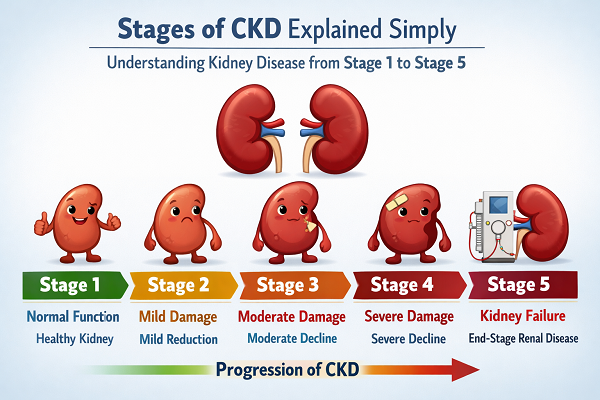
Key Takeaways
More than 850 million individuals are estimated to have kidney disease across the globe, and therefore, it is among the fastest-growing chronic health problems.
About 90% of individuals who have CKD do not realize that they have the disease since symptoms are usually absent until there is a significant decrease in kidney function.
The physician uses eGFR levels and urine tests to establish kidney damage and determine CKD stages.
Stage three is the most common because symptoms usually develop at this stage.
Early intervention could slow down disease development.
What Is Chronic Kidney Disease (CKD)?
Chronic Kidney Disease (CKD) is an ailment that entails the gradual loss of the kidneys’ function to cleanse the blood of harmful substances. Under normal conditions, healthy kidneys clean up about 180 liters of blood per day to keep an appropriate balance of fluid, electrolytes, and minerals. When the function of the organs decreases for more than three months, it indicates CKD. In the view of the International Society of Nephrology, one out of ten people has chronic kidney disease; however, many patients are not diagnosed since the ailment progresses rather slowly.
Why do doctors categorize CKD into Various Stages?
It is important to note that each individual has his/her own course of the ailment. Some have stable kidney function for years, while others whose condition that deteriorates quickly. Thus, in order to control the process, it is necessary to categorize CKD into five stages based mainly on eGFR values. It enables physicians to choose appropriate treatment and medications for each patient.
What Are the Ways to Diagnose CKD?
CKD cannot be diagnosed based only on the symptoms. There is a combination of tests that help diagnose the disease and measure its severity.
Blood Creatinine Test
Creatinine is a natural by-product of metabolism generated by muscles during physical activity. Normally, creatinine is removed from the bloodstream with the help of kidneys. High levels of creatinine mean impaired kidney function.
eGFR Test
The estimated Glomerular Filtration Rate (eGFR) is the key value that shows how the kidneys work. The eGFR values depend on the level of blood creatinine, age, and gender. Normally, an adult has an eGFR above 90 mL/min/1.73 m², though eGFR slightly decreases with age.
Urine Albumin-to-Creatinine Ratio (ACR)
If the levels of eGFR are normal, but there is a leakage of proteins into the urine, it means that there is some kidney damage. ACR test measures the levels of albumin in urine and is an essential test in kidney damage classification.
Imaging Tests
It is possible to have ultrasounds or CT scans to detect kidney stones, cysts, and other problems with the kidneys, which may cause CKD.
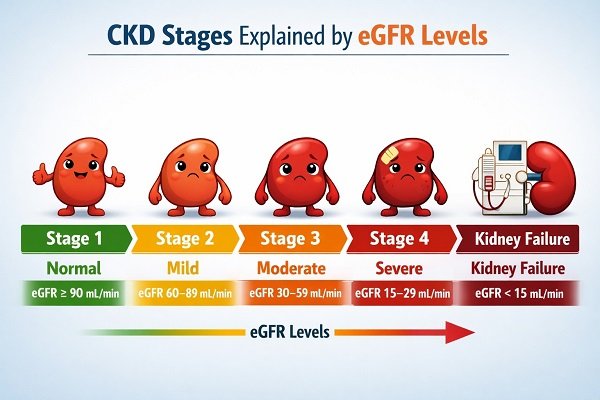
Elevated eGFR Levels and Staging of Kidney Damage
The kidneys have more than a million filters known as nephrons in each of the two kidneys. The deterioration of the filters results in a gradual loss of function by the kidneys in cleaning the blood, and this is indicated by elevated eGFR levels.
| CKD Stage | eGFR (mL/min/1.73 m²) | Kidney Function |
|---|---|---|
| Stage 1 | 90 or above | Normal function with signs of kidney damage |
| Stage 2 | 60–89 | Mild reduction in kidney function |
| Stage 3A | 45–59 | Mild to moderate reduction |
| Stage 3B | 30–44 | Moderate to severe reduction |
| Stage 4 | 15–29 | Severe loss of kidney function |
| Stage 5 | Below 15 | Kidney failure |
It is also important to be aware of the fact that in the process of staging kidney damage, the diagnosis cannot be made based on only one blood test. The amount of protein in the urine, the patient’s blood pressure, the outcome of imaging procedures, and the general state of health are taken into account by specialists.
Stage 1 CKD
eGFR: 90 ml/min or higher
Stage 1 is the first stage of chronic kidney disease. The kidneys continue to function normally, but there are some signs of kidney damage, including protein in the urine or abnormality on imaging scans. Due to relatively normal functioning, no symptoms occur. That is why regular health checkups play an essential role.
Some of the most common reasons are diabetes, high blood pressure, genetic kidney problems, and recurrent kidney infections. It was found that proper treatment of blood pressure and blood glucose levels reduces the chances of disease progression.
What You Should Do
- Keep blood pressure lower than your target level.
- If you have diabetes, control it strictly.
- Get at least 150 minutes of exercise a week.
- Cut down on extra salt and processed foods.
- Do not smoke and limit alcohol use.
- Get regular kidney function assessments.
The earlier you start, the more time you will be able to keep your kidneys healthy.
CKD Stage 2
eGFR: 60-89
Stage 2 is characterized by a minor reduction in the efficiency of the kidneys, although most people continue to be entirely healthy. At this stage, the kidneys are still able to do most of their job, but there are signs of damage detected by lab tests.
The symptoms experienced by some patients include minor changes in urination habits, such as frequent nighttime urination and foamy urine caused by the leakage of proteins. Yet, most patients remain symptom-free.
Medical practitioners normally suggest the following measures:
- Having a proper weight.
- Keeping blood cholesterol within a normal range.
- Eating a special kidney diet.
- Consuming recommended amounts of fluids.
- Monitoring eGFR level and urine proteins.
Several scientific studies have found that patients whose diabetes and high blood pressure are under control at Stage 2, are much less likely to advance to severe CKD stages.
Comparison Between CKD Stages 3A and 3B
Stage 3A (eGFR: 45-59)
Stage 3A indicates that there is enough loss of kidney function that signs or symptoms start appearing. There is a gradual accumulation of waste substances in the body because the kidneys can no longer filter them out, but most individuals do not have any complaints.
Symptoms include:
- Fatigue
- High blood pressure
- Swelling in the ankles
- Urinary problems
The doctor prescribes more frequent testing of kidney function and recommends consulting a renal dietitian in order to make adjustments in sodium, potassium, and protein consumption.
Stage 3B (eGFR: 30-44)
In stage 3B, a patient has already experienced significant loss of kidney function. Studies reveal that when eGFR drops below 45, the likelihood of developing cardiovascular disease becomes much higher.
Symptoms can include:
- Constant fatigue
- Edema and swelling of the ankles or legs
- Muscle cramps
- Lack of appetite
- Dry or itchy skin
- High blood pressure
The medical team is closely monitoring such parameters as eGFR, anaemia, bone metabolism, and electrolyte balance. Although there is no cure for kidney damage, appropriate therapy will help to stop or slow down its progress and lead to the long-term survival of a patient.
CKD Stage 4
eGFR: 15–29
Stage 4 CKD implies severe damage to the kidneys, which is unable to clear waste products from the blood and get rid of surplus fluids properly. In this case, the kidneys only have 15-29 percent of their full functioning capacity left. Kidney experts state that people suffering from Stage 4 CKD should be monitored carefully since the danger of developing kidney failure grows in the next couple of years due to the ongoing progression of the disease.
Individuals suffer from more evident symptoms in this case since toxins begin accumulating in the bloodstream.
Typical Symptoms
- Fatigue
- Reduced appetite
- Nausea
- Lack of concentration
- Hypertension
- Retention of fluids in the feet, ankles, hands, and even around the eyes
- Increased frequency of urinary changes, such as reduced urine output and nocturia
All of these symptoms arise because damaged kidneys cannot balance the fluid and electrolyte levels within the body properly.
What Takes Place in Stage 4?
Physicians start to prepare patients for their treatment in the future while preserving their kidney function.
Typical treatments involve:
- Periodic checking of eGFR levels (every month or regularly)
- Blood testing for potassium, phosphorus, calcium, and haemoglobin levels
- Careful regulation of blood pressure
- Nutrition that is kind to the kidneys
- Taking no drugs that can harm the kidneys
- Consultations with a nephrologist (if the patient has not already seen one)
Scientists have found that people who were provided with special kidney care in stage 4 have less need for hospitalization and are better prepared if dialysis is required.
Stage 5 CKD
eGFR: Less than 15
Stage 5 CKD is also called kidney failure or End-Stage Kidney Disease (ESKD). In Stage 5, the kidneys lose almost all their ability to filter the waste and excess fluids, which can then accumulate in large quantities in the body.
Despite CKD stages being the signs of the development of chronic kidney disease, Stage 5 does not necessarily require immediate starting dialysis. The doctor will take into account the patient’s symptoms, the result of blood tests, and general health state when deciding on treatment.
Typical Symptoms
- Extreme weakness
- Chronic nausea and vomiting
- Intensive edema and swelling
- Breathlessness because of fluid retention
- Insomnia
- Loss of appetite
- Unpleasant metallic taste in the mouth
- Intense changes in urination patterns, especially decreased production of urine
- Options of Treatment
According to the patient’s state, there can be the following options of treatment:
- Hemodialysis
- Peritoneal dialysis
- Kidney transplantation
- Conservative treatment of CKD for certain patients
The option of kidney transplantation provides the best quality of life for suitable patients, but there are many cases of successful living on dialysis treatment.
Symptoms That May Occur During the Various Stages of CKD
The main problem with chronic kidney disease is that the symptoms usually start to show up slowly. Patients tend to be totally well at the beginning CKD stages, which is why testing is so vital.
| CKD Stage | Common Symptoms |
|---|---|
| Stage 1 | Usually no symptoms |
| Stage 2 | Mild changes in urination patterns, protein in urine |
| Stage 3 | Fatigue, high blood pressure, mild swelling |
| Stage 4 | Edema and swelling, nausea, itching, poor appetite |
| Stage 5 | Severe swelling, breathing difficulty, extreme fatigue, reduced urine output |
Understanding eGFR Results Without Any Medical Terms (Guide for 2026)
Getting a blood test result may be difficult for someone who is not familiar with medical terminology. It is important to understand what the levels of your eGFR are.
Step 1: Look for Your eGFR
Your lab report normally lists your eGFR right after your creatinine value.
Interpretation of general results:
- Above 90 – Normal functioning of kidneys (if no kidney damage detected)
- 60-89 – Kidney functioning slightly decreased
- 45-59 – Stage 3A
- 30-44 – Stage 3B
- 15-29 – Stage 4
- Below 15 – Stage 5
Step 2: Look at Your Creatinine
Elevated values of creatinine indicate that your kidneys have lower efficiency in the process of filtration. But also, creatinine can be affected by age, muscle mass, and medication.
Step 3: Look at Your Urine Report
Physicians normally order the Albumin-to-Creatinine Ratio (ACR) along with a blood test. The presence of protein in the urine may show signs of kidney disease regardless of eGFR level.
Step 4: No Need to Freak out Over Just One Test
A single abnormal test result is not always proof that someone has CKD. Dehydration, having a fever, taking certain medicines, or recently being ill may influence how the kidneys work.
When Do You Need to Visit a Nephrologist?
Most people only consult a kidney expert when the symptoms are quite severe. But usually, an early visit helps in obtaining better results.
You should see a nephrologist if you have any of the following symptoms:
- Consistent presence of protein in your urine
- Presence of blood in your urine
- Difficulty controlling high blood pressure
- Diabetes with decreasing efficiency of the kidneys
- eGFR less than 60
- Family history of kidney diseases
- Persistent edema and swelling
- Changes in urination patterns
An early visit will help in providing timely treatment and diet advice.
FAQS
Is Stage 1 CKD curable?
While Stage 1 CKD may not always be curable, its treatment may prevent or significantly delay disease progression.
What is the normal eGFR value?
Normal eGFR is 90 mL/min/1.73 m² or more, as long as there are no additional signs of kidney injury.
Is Stage 3 CKD serious?
It is indeed. The stage shows moderate damage; hence, regular checks and therapy are required to slow down its progress.
Can CKD get better?
The damage itself does not heal; however, therapy can help stabilize kidney function in some patients for several years.
Do all people with Stage 5 CKD require dialysis?
No, at least not right away; the choice will depend on symptoms, tests, and overall state of health, not only eGFR.